Last updated: 8-21-26
the time-cost of content
All media has a time-cost. Anything we create will take some amount of time to consume. But not all media has the same time-cost.
For example:
- an image has almost no required time-cost. It can typically be instantly observed in its entirety; any remaining time spent is at the sole discretion of the audience
- the time-cost of written text is almost completely subjective. It is dependent on the reading speed of the audience, but it can also be skimmed and stopped or started from any point the reader wishes
- recorded audio has a semi-fixed time-cost. It can be sped up or slowed down, but with varying levels of detriment to the effect of the message (i.e. speech can be sped up to any point that the hearer can comprehend, but music will lose most of its intended impact if not heard at its original tempo)
- video has the most rigid time-cost. It can also be sped up or slowed down, but it is least desirable to do this with video because of the effect it has on both the audio and the natural movement of the visuals and pacing of the edit, etc.
In order to avoid wasting our audience’s time, it is necessary to at least make a basic assessment of how much time we are asking them to spend in the first place.
~ ~ ~
P.S. Taking advantage of the tools in our publication platforms such as video or podcast chapters or a table of contents for a blog post are also courtesies we can extend that give the audience more agency over their time-spend with our content.
paying attention
I’ve written before about the time-cost of content, but time is not the only cost associated with consuming content.
If I were to lay out a more complete picture of this time-for-content exchange, it would probably look something like this:
content costs attention
attention costs time
time costs opportunity
Of these three costs — opportunity, time, and attention — attention is maybe the most important. I really don’t think that many people consider seriously enough the implications of asking others to pay attention to their content. After all, attention is the raw material which makes up our very experience of existence.
In her 2009 book Rapt: Attention and the Focused Life, Winifred Gallagher puts it this way:
“
If you could look backwards at your years thus far, you’d see that your life has been fashioned by what you’ve paid attention to and what you haven’t. You’d observe that of the myriad sights and sounds, thoughts and feelings that you could have focused on, you selected a relative few, which became what you’ve confidently called “reality.” You’d also be struck by the fact that if you had paid attention to other things, your reality and your life would be very different.
Seen in this light, I think everyone who creates content would have a much different idea of the responsibility that comes with asking others for attention.1
One way to be conscientious about this reality is to ask yourself when you begin to create content:
“How do I want people to be different after they experience my content?”
Because people will be different after they experience your content.
- there is also responsibility associated with the paying of attention, but that is not the issue at hand ↩︎

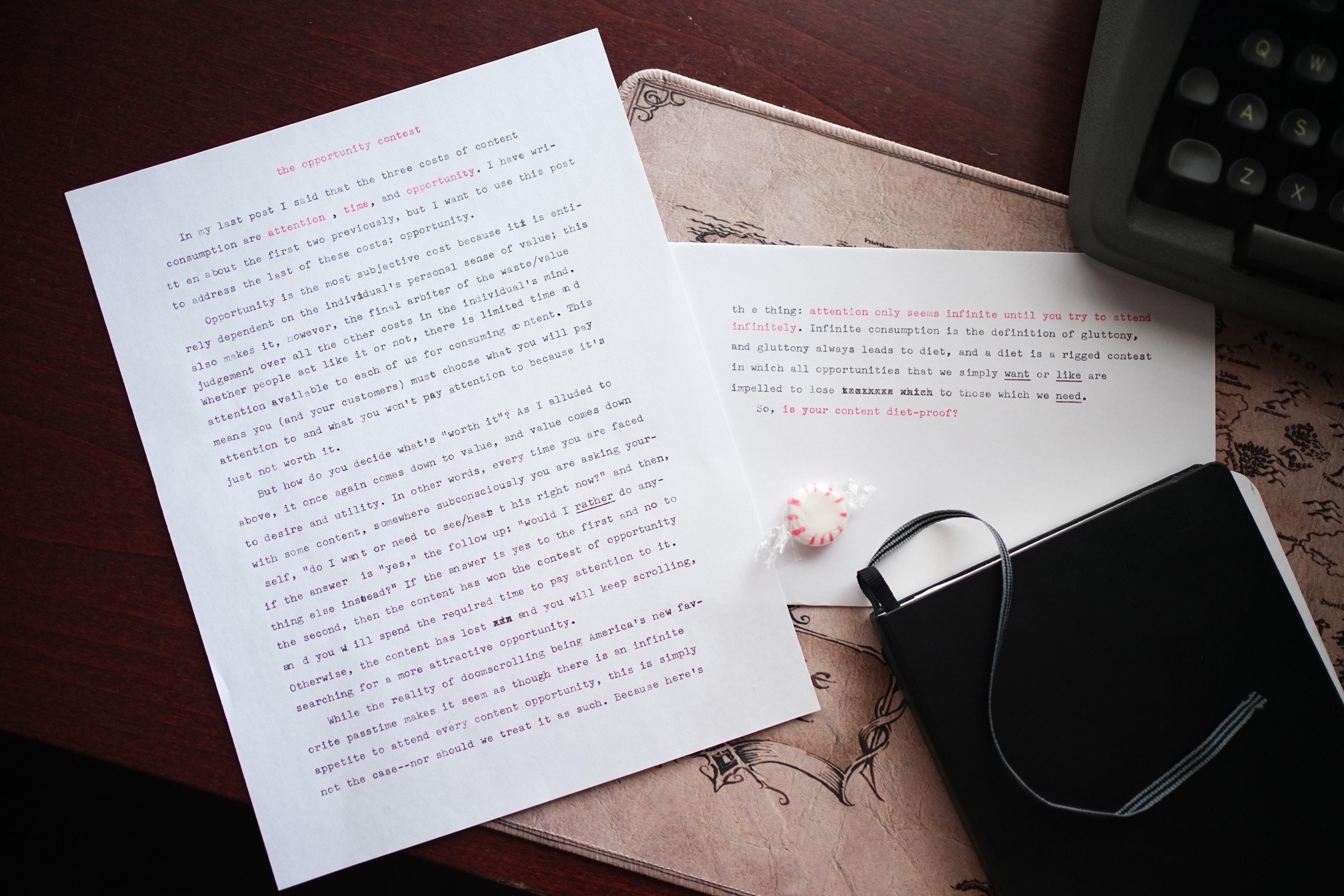
the opportunity contest
In my last post I said that the three costs of content consumption are attention, time, and opportunity. I have written about the first two previously, but I want to use this post to address the last of these costs: opportunity.
Opportunity is the most subjective cost because it is entirely dependent on the individual’s personal sense of value; this also makes it, however, the final arbiter of the waste/value judgement over all the other costs in the individual’s mind. Whether people act like it or not, there is limited time and attention available to each of us for consuming content. This means you (and your customers) must choose what you will pay attention to and what you won’t.
But how do you decide?
As I alluded to above, it once again comes down to value, and value comes down to desire and utility. In other words, every time you are faced with some content, somewhere subconsciously you are asking yourself:
“Do I want or need to see/hear this right now?”1
And then, if the answer is “yes,” the follow up:
“Do I want or need to do anything else instead?”2
If the answer is “yes” to the first and “no” to the second, then the content has won the contest of opportunity and you will spend the time required to pay attention to it. Otherwise, the content has lost and you will keep scrolling, searching for a more attractive opportunity.
While the reality of doomscrolling as America’s new favorite pastime makes it seem as though every person has an infinite appetite to attend every content opportunity, this is simply not the case—nor should we treat it as such.
Because here’s the thing:
Attention only seems infinite until you try to attend infinitely.
Afterall, infinite consumption is the definition of gluttony.
And gluttony will always lead to diet.
And a diet is a rigged contest in which all opportunities that we simply want or like are impelled to lose to those which we need.
So . . .
Is your content diet-proof?
- this establishes that it may offer something of value to you ↩︎
- this weighs the value of this opportunity against the potential value of all other opportunities ↩︎
wasted time
When it comes to spending our time and attention, “waste” comes in (at least) three forms:
opportunity cost
This is the underlying factor of all forms of time waste. This is what we feel when, after spending time in one manner, we retrospectively feel like we would have derived greater gain from doing something else.
net negative experience
This has to do with the residual emotional effect of an experience. Even if we achieve the greatest ROI from our time, if we are left with a negative feeling about it, we will probably still consider our time better spend elsewise.
unmet expectations
And further, even if our time yielded a positive gain and a net positive emotional experience, still, if we feel the experience fell short of the expected or promised experience, we may nonetheless consider it to have been a waste based solely on the prospect of an imagined opportunity cost which has been left unrealized.
~ ~ ~
Admittedly, “waste” is just as subjective of a judgement as “value” is, but understanding and keeping in mind these three aspects of attentional waste can help us to mitigate as much of it as possible when developing our content.
(this article has been compiled from messages sent in my newsletter)