Last updated: 9-21-26
how *not* to write content like AI
AI content marketing is here. And it all sounds the same.
But the real problem is, it also sounds the same as all the humans who have been filling the internet with high-volume, low-value SEO fodder for years.
How many times have you read a variation on:
12 questions to ask before hiring a *insert-your-industry-here* company
(and why we meet all the requirements)
You (or anyone else) could write that article for your business right now in the blink of AI.
So, can we do better?
I think so.
In my opinion, the best way to not sound like AI is to:
- start from a place that AI can’t (i.e. your personal lived experiences and applied knowledge)
and from there . . .
- make unexpected, complex, or abstract connections between concepts which provide genuine insights to other humans (but which probably won’t make much sense to robots)
But whatever your strategy ends up being, go make something that is not in danger of people asking themselves: “did AI write this?”
balderdash and you
There’s a classic board game called Balderdash wherein one player holds a card with an extremely obscure, but real, word and its definition.
The goal of the other players is to write down definitions for this word which sound like they could be associated with the word to try to fool the other players into voting for theirs as the correct answer.
In case you were unaware, this is (simplistically) how AI LLM systems like ChatGPT work. They scour their language database and mountains of internet metadata to provide responses to questions which sound like they could be the right answer, but in reality they have no way of knowing how accurate it is, although they do a pretty good job of getting pretty close, most of the time.
So, while everyone else is getting could be answers to their questions via AI and trying to figure out how accurate it might be, your job, expert, is to show the card with the real definition on it.
AI fatigue
The other day I was on the website of a local small business which provides a technical expertise service and I found an article on their blog about “AI fatigue.”
The article explained how the AI hype is wearing out and companies are re-hiring human specialists to provide more value to customers.
And then it pulled its punches at the end by concluding with a point about how the “smarter model” is using the combined power of humans and AI together to provide improvements in both innovation and efficiency (which we know is counter productive based on the innoficiency principle).
My initial reaction was that this is a somewhat milquetoast take, but, by that same token it’s hard to argue too strongly with since it doesn’t really have a hard stance one way or the other.
Then I noticed something. There was a disclaimer at the bottom of the article.
The article was produced by an “article aggregator” service.
That’s right. An article about AI fatigue which starts by explaining how everyone is sick of AI and ends by defending AI’s place in your workflow, was literally written by AI.
I could say more about this particular version of content farming, but for now, here’s the point:
AI fatigue is real and AI content farming is making it worse.
If you really want to be viewed as an expert in your field, you need to speak in your own voice. It is the only way to be both clear and authentic.
It used to be the only way to create content.
Now it’s a hit of oxygen in a stagnating bog of recycled and regurgitated slop.
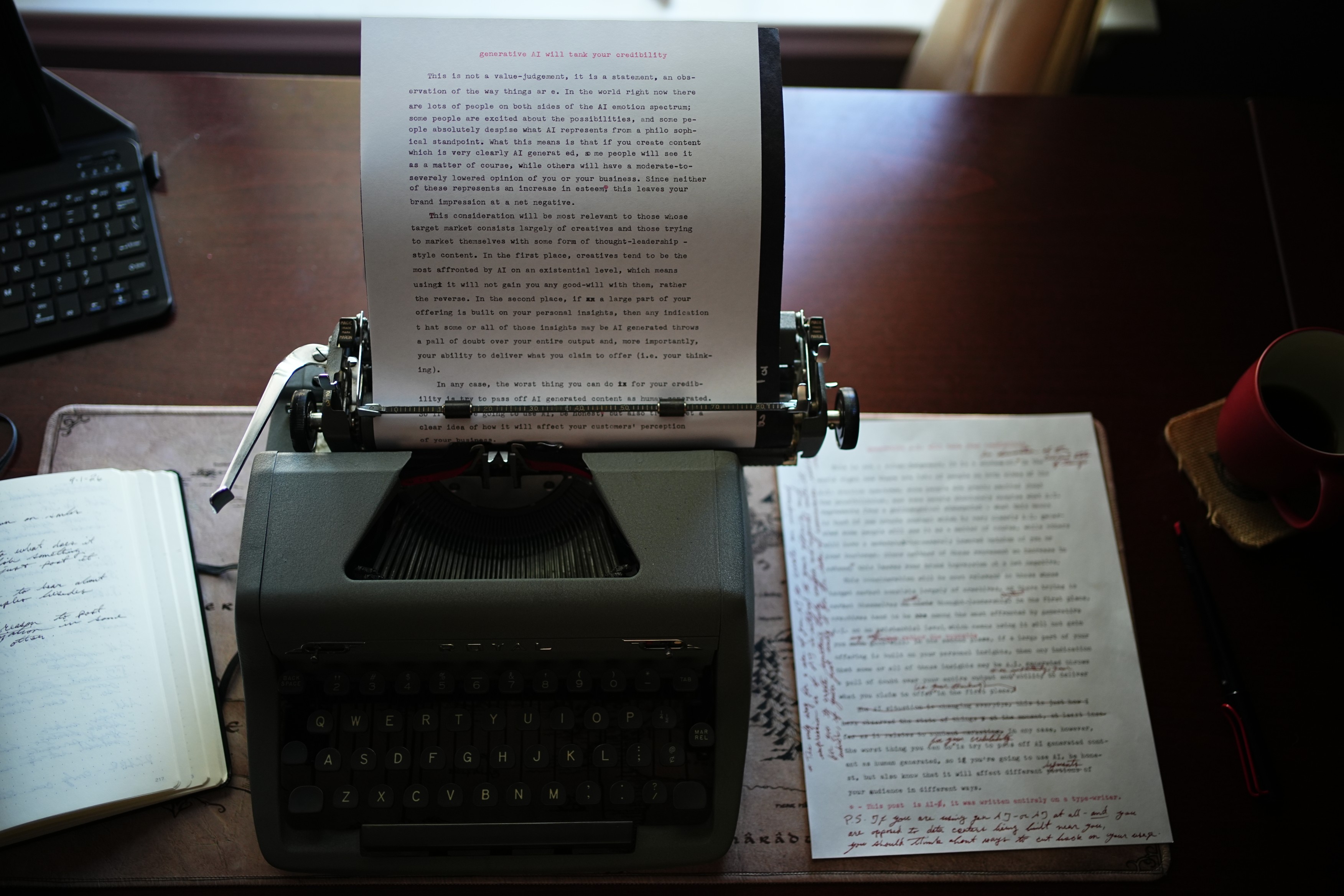
generative AI is bad for credibility
This is not a value-judgement, it is a statement, an observation of the way things are; albeit based on my personal experience and anecdotal evidence.
In the world right now there are lots of people on both sides of the A.I. emotion spectrum; some people are excited about the possibilities, and some people absolutely despise what A.I. represents from a philosophical standpoint.
What this means is that if you create content which is detectibly A.I. generated, some people will see it as a matter of course, while others will have a moderate-to-severely lowered opinion of your business1. Since neither of these represents an increase in esteem2, this leaves your brand impression at a net negative.
I think this consideration will be most relevant to those whose target market consists largely of creatives, and those trying to market themselves with some form of thought-leadership-style content.
In the first place, creatives tend to be among the most affronted by A.I. on an existential level, which means leaning into it will not gain you any good-will with that segment, rather the reverse.
In the second place, if a large part of your offering is built on your personal insights, then any indication that some part of those insights are A.I. generated will cast a pall of doubt over your entire output and, more importantly, your ability to deliver what you claim to offer (i.e. your thinking). It’s like playing Scrabble online with someone that you caught using Scrabble Word Finder once—for the rest of the game you’re never quite sure how authentic their moves are.
But in any case, the worst thing you can do for your credibility is to try to pass off A.I. generated content as human-generated. So if you’re going to use A.I., be honest3 (i.e. authentic), but also make sure you have a clear idea of how it will affect your customers’ perception of your business.
- I have been surprised at the number of people who are unaware of the viscerally negative reaction that many people have to the use of A.I. (which is part of the reason for this post). I’d say much more people are excited to create content with A.I. than anyone is to consume A.I. created content, but that may be a topic for a different post. ↩︎
- The only way for a use of generative A.I. to create an improved impression is if either A.I. is an integral part of your offering to begin with and/or you can manage to create something truly unique and valuable with it—which, if you’re simply using it for the sake of your own speed, cost, and convenience, is unlikely. ↩︎
- The disclosure of A.I. is becoming more common and people are developing interesting methods of doing so, for instance this A.I. contribution scale by Blair Enns. By that scale, this post—and every post in this newsletter—is AI-0. ↩︎
(this article has been compiled from messages sent in my newsletter)