Last updated: 9-4-25
authenticity
Ah, that coveted word:
authenticity
The golden calf of marketing.
Oh to be able to create content that seems as natural as if it weren’t marketing at all.
The problem is, once the audience gets a whiff of sales, your perceived authenticity disappears instantly.
And yet, as small businesses with an intimate knowledge of our niche customer base, authenticity seems like a natural approach to communication.
But before we can apply authenticity appropriately, we have to remember what it is.
At it’s core, authenticity means transparency. It means that a thing is what it claims to be. It means not pretending or having ulterior motives.
With that in mind, here are two methods for applying authenticity:
method 1
Don’t sell.
If you don’t want your content to look like sales content, then it should be genuinely and primarily concerned with benefitting your audience (i.e. providing value) and be content to let the sales follow, or not, as they may.
method 2
Be honest about your intent to sell.
If your content is primarily about how great your product or service is, just lean into it. Even going over-the-top on honest sales builds trust better than pretending sales is something else.
~ ~ ~
Either way, the key to authenticity is making your intentions known.
There may be other ways to be sneaky or clever about marketing, but people are pretty good at picking up on true authenticity. Once you hit that uncanny valley of false authenticity, you’re in danger of making the audience feel taken advantage of, which is a good way to burn a bridge.
two flavors of false authenticity
I am fascinated, and a little baffled, by false authenticity.
The very contradiction in terms should inherently invalidate it as a strategy, but we see it everywhere and the trend is not going away anytime soon.
At it’s core, false authenticity in marketing means paying someone to pretend to love your product or service.
As I see it, there are two distinct flavors of false authenticity, which for simplicity’s sake we’ll call “lo-fi” and “hi-fi” false authenticity.
lo-fi false authenticity
The technical name for this kind of false authenticity is “user generated content” or UGC.
This is when a company pays a person (generally someone without a large existing audience base) to create content as if it were a spontaneous review or genuine reaction.
This is pretty popular with companies because it’s cheaper than sponsoring someone with an audience and it usually blends in fairly well with the actual authentic content on social media.
hi-fi false authenticity
This is the strangest form of false authenticity to me because it’s so obvious.
This is when a company creates highly produced marketing content which pretends that it is a popular form of content which would otherwise be fairly low in production quality.
For example, large tech companies using their huge budgets to fake a hipster podcast or the spontaneous man-on-the-street style interviews which are popular on TikTok.
~ ~ ~
But no matter which flavor you choose, the use of the false authenticity charade is always primarily concerned with capturing value rather than providing it.
If you really want your business to come across as authentic, it seems much easier to find a way to speak directly to your audience than to concoct an elaborate game of make-believe.
authenticity is free
When you start producing content, especially if you want to be taken seriously, it can be intimidating to think of all the things you need to have or learn in order to have adequate production value.
But when you don’t have production value, what you do have is authenticity, because what you’re producing and showing is the way things actually are, not the way you’ve designed them to appear.
Here’s a clip of Linus from Linus Media Group, which operates several of the largest tech content channels on YouTube, talking about the transition from recording at home to having a dedicated studio space:
watch clip (56s) >>
Interestingly, what Linus calls “production value” in the clip I think would be more accurately termed “authenticity.” But, in the world of YouTube, authenticity is the primary measure of production value.
Here’s a graph I sketched that I think represents what Linus is gesturing at in the clip:
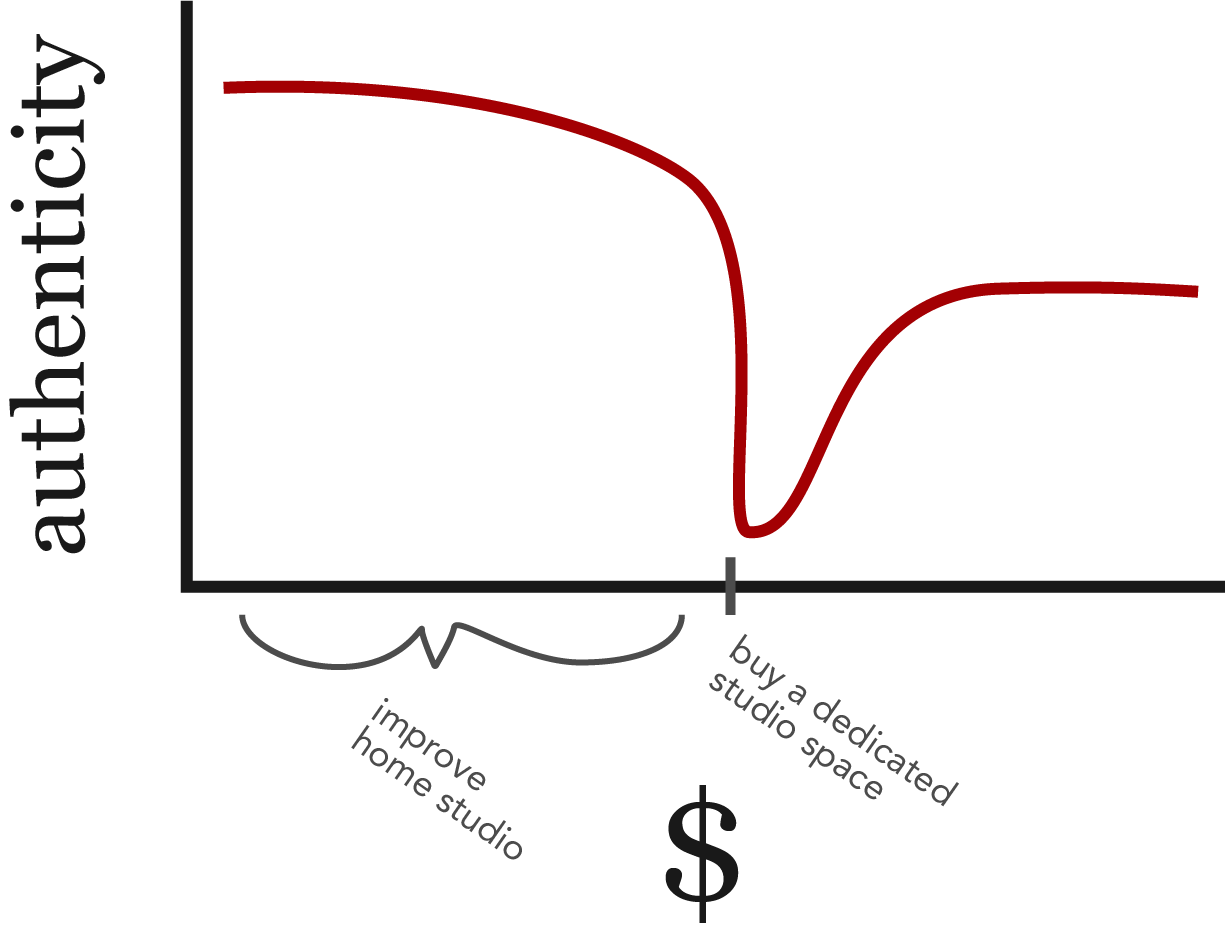
Notice how even after you spend a lot of money to recreate the authenticity that comes for free, you will never completely reach that level again because the new production environment is inherently fabricated.
Now, there is a trust that comes from the establishment of actual production value and a production environment, but I’m not sure that it’s necessarily a greater level of trust than that which comes from real, free authenticity.
And the good news is that right now, with absolutely nothing, you’re already at the peak of the authenticity curve.
So take advantage of it.
be how you want to appear
If your goal really is authenticity, and authenticity means transparency or showing the way things actually are, then that means you will be revealing much more of the good, the bad, and the ugly of your product, service, or organization.
It means that ultimately your goal should not be to use your content to make your product, service, or organization appear to be a certain way;
your goal should be to make your product, service, or organization be the way you want it to appear in your content.
If you can do that, then all you have to do is hit record.
(this article has been compiled from messages sent in my newsletter)