“
“A merry Christmas, uncle! God save you!” cried a cheerful voice. It was the voice of Scrooge’s nephew, who came upon him so quickly that this was the first intimation he had of his approach.
“Bah!” said Scrooge. “Humbug!”
This exchange happens in the opening pages of Charles Dickens’ A Christmas Carol. It is, in fact, the first dialogue in the story and also the inciting incident of all that follows—which is why, in my humble opinion, Scrooge’s nephew Fred may be the most important, and most overlooked, character in the entire story.
The Prayer
Fred appears, in person, three times in the short book. As noted above, his first appearance is the first diegetic interaction in the story.
Here we see Fred as, truly, the first spirit that Scrooge encounters, the embodiment of the Christmas spirit and the harbinger of those to come. The description of his entrance calls to mind the “glow” and “fog” which we might associate with a ghost, manifested by the winter setting.
“
He had so heated himself with rapid walking in the fog and frost, this nephew of Scrooge’s, that he was all in a glow; his face was ruddy and handsome; his eyes sparkled, and his breath smoked again.
On his arrival, Fred “spooks” his uncle by entering unnoticed and saying a sort of prayer over him—”God save you!”
An interesting choice of words. Shouldn’t he, like Tiny Tim, or the caroler a few pages later, have rather said “God bless you”?
And yet, the rest of the tale—in which a spiritual trinity guides Scrooge through a journey of metanoia and mortification—is in fact the telling of how this simple, three-word prayer was answered.
The Party
But, come now, was it really Fred who called the spirits down upon Scrooge, causing him a night of inestimable terror and remorse and utterly annihilating his former way of life?
Indeed. And I believe this is Fred’s intention. He says as much himself, though perhaps not in so many words.
During the excursion with The Ghost of Christmas Present we see Fred again, hosting the party to which he invited Scrooge in the beginning, and providing his own interpretation of their meeting:
“
“I mean to give him the same chance every year, whether he likes it or not, for I pity him. He may rail at Christmas till he dies, but he can’t help thinking better of it—I defy him—if he finds me going there, in good temper, year after year, and saying, ‘Uncle Scrooge, how are you?’ If it only put him in the vein to leave his poor clerk fifty pounds, that’s something; and I think I shook him yesterday.”
It was [the guests’] turn to laugh now, at the notion of his shaking Scrooge.
But shake Scrooge he did. Shake him to his very core.
The Prodigal
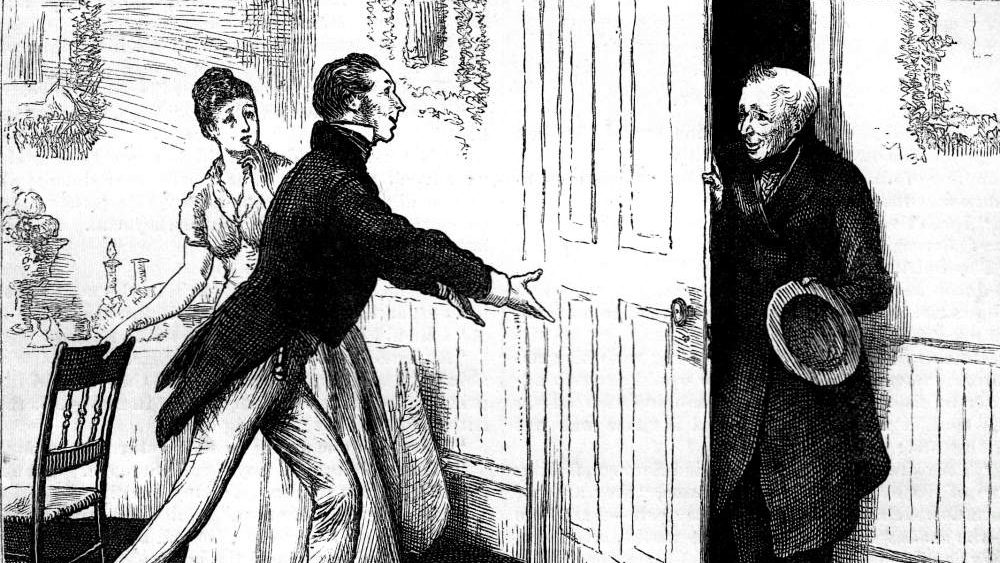
Fred’s last appearance, after the spiritual pilgrimage and ultimate conversion of his uncle, shows two reversals. The first is the reversal of the opening scene, for now it is Scrooge’s turn to spook Fred.
“
He turned [the knob] gently, and sidled his face in round the door . . .
“Fred!” said Scrooge.
Dear heart alive, how his niece by marriage started! Scrooge had forgotten, for the moment, about her sitting in the corner with the footstool, or he wouldn’t have done it on any account —
And the second reversal we see is that of the parable of the prodigal son. We see an uncle, who should have been like a father, but instead abandoned his orphaned nephew in favor of squandering his great wealth—by never spending a penny of it—and here we also see that prodigal uncle welcomed, without question or hesitation, to the Christmas feast by the same long-slighted nephew.
“
— “Why, bless my soul!” cried Fred, “who’s that?”
“It’s I. Your uncle Scrooge. I have come to dinner. Will you let me in, Fred?”
Let him in! It is a mercy he didn’t shake his arm off. He was at home in five minutes. Nothing could be heartier.
The Proverb
So three cheers for Fred!
May we all strive to be a little more like Fred this Christmas. Fred, who was the most powerful of the Christmas sprits, because he was not a ghost, but a man. A man who could say a prayer and invite to a party and welcome a prodigal, and who knew how to fight the good fight, as taught in the ancient wisdom of King Solomon:
“
If your enemy is hungry, give him bread to eat,
and if he is thirsty, give him water to drink,
for you will heap burning coals on his head,
and the LORD will reward you.
— Proverbs 25:21–22