Note: I started writing this post last January, however at that time I didn’t have anywhere to post it, so it never materialized. Nonetheless, resolutions are cheap to make and costly to hold, so maybe it’s better after all to look at them now, a year later, and skip the wishful post about undone resolutions for the year ahead.
So here’s what I wrote last year, with some bits updated with the benefit of hindsight (although, frankly, I didn’t have to change nearly as much as I expected).
On resolutions
I consider myself a fairly reasonable person. And like other fairly reasonable people, I have mostly abandoned the idea of New Year’s resolutions. But somewhere down the line I got this warped idea that Benjamin Franklin formatted his resolutions as a manifesto of sorts, each point starting with the word “resolved.”1 For some reason this struck me and I occasionally find myself creating “resolved lists” of things I would like to improve in myself, which act more like guiding policies than a wish list of improved qualities to be picked off a shelf. Maybe it’s the fact that “resolved” is past tense. It has been resolved, therefore it is in effect. There is no striving or wanting involved in what is active policy, ergo there is no opportunity for noncompliance (of course, that’s not really how it works, but it keeps you on the rails a little longer).
It may also be worth noting that I find time-based goals or resolutions lead almost invariably to disappointment (those which have to start on a certain day and/or hold for x number of days or weeks to follow). In my experience, the policies I tend to stick to for the longest are the ones invented on a whim or in the spur of the moment and which aren’t held too rigidly in the execution. That being said, there are definitely certain temporal landmarks in life which seem to naturally produce a heightened sense of motivation (or resolve, if you will). In my case, I had one of those landmark moments early in December of 2024, which of course coupled with the arbitrary turning of the year to make this simultaneously something of a year-start resolved list.
So, without further ado . . .
Resolved – 2025
~ ~ ~
I – Observe sacredness
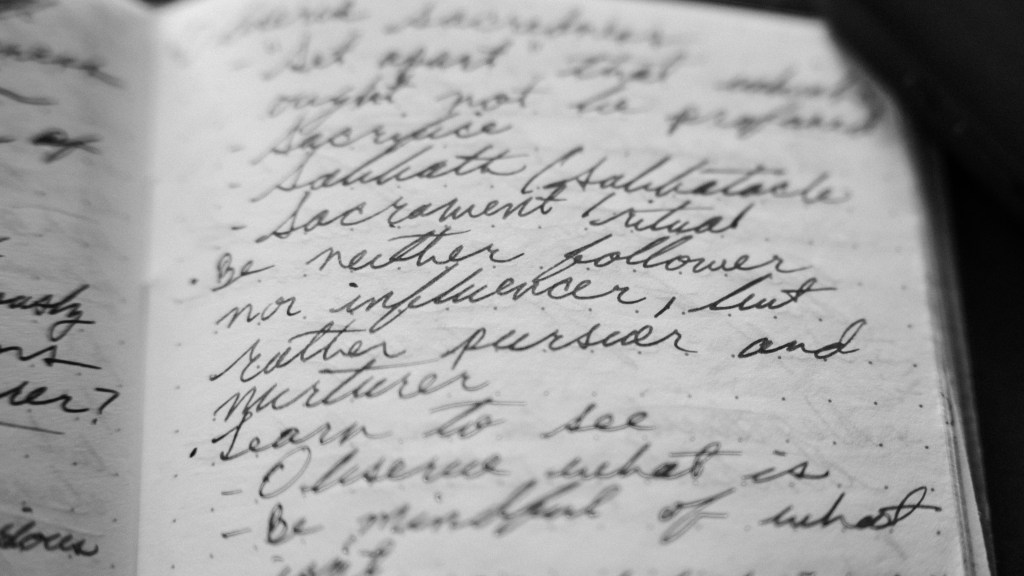
The word “sacred” is the crux of this resolution. It literally means “set apart,” and it is something that I did actually spend a lot of time thinking about over the last year. I’m still working out what it looks like practically in a variety of ways, but it is often on my mind.
Setting apart that which deserves undivided attention from trivial or counter-productive intrusions seems straightforward, but turns out to be more difficult in practice, at least in my experience. But that’s why I like the gravitas of a word like sacred. It carries a lot of meaning with it. It implies sacrifice, the intentional giving up of some of the best or most cherished things for the most important things—the subjective for the objective. It involves sacrament, or rituals, which are often key to avoiding the sacrilege of mixing the trivial and the important. And, maybe most importantly, sacredness invokes sabbath. The setting apart and prioritizing of rest.
II – Neither a follower nor an influencer be; be rather a pursuer and nurturer
Here we have a case of simple reframing. I have been on a years-long mission to eradicate the idea of “following” from my digital experience as a whole, even going so far as to construct a rudimentary app for cataloging web URLs in an effort to replace my digital feeds2.
Following is passive, which makes it an appropriate term for the social media context in which content is served up without any effort on the part of the follower. It is a lazy river or a moving sidewalk. Pursuing, on the other hand, is active. It makes you think about your destination before choosing a direction. It is a forked path in the woods, or a wrinkly paper map. Choice is not possible in the act of following, whereas pursuing is not possible without choice.
In contrast, “influence,” to me, is too active a term. It puts the agency on the “influencer” to make choices and decisions for someone else to adopt. Nurturing, on the other hand, is about shaping an environment and providing adequate material—or nutrients—for growth and development while allowing the specifics of decision making to be left to the other. This seems a healthier mindset for both digital content creation as well as, what is more important personally, family life and fatherhood (i.e. “husbandry”).
Admittedly, I am not a so-called “influencer” in almost any sense of the word, but I am technically a content creator and an entrepreneur by trade (if not by accident), which puts me perilously close to the edge in some respect. This has also been on my mind a lot in 2025 as I have tried to start posting content for myself and my business in a way which respects the attention of anyone willing to pursue the same things I am.
Below, if you wish, you can read a quote by Wendell Berry about the difference between nurturers and exploiters, as he sees it, which was one of the primary shaping factors of this resolution.
Read quote
Nurturer vs Exploiter
“
Let me outline as briefly as I can what seem to me the characteristics of these opposite kinds of mind. I conceive a strip-miner to be a model exploiter, and as a model nurturer I take the old-fashioned idea or ideal of a farmer. The exploiter is a specialist, an expert; the nurturer is not. The standard of the exploiter is efficiency; the standard of the nurturer is care. The exploiter’s goal is money, profit; the nurturer’s goal is health—his land’s health, his own, his family’s, his community’s, his country’s. Whereas the exploiter asks of a piece of land only how much and how quickly it can be made to produce, the nurturer asks a question that is much more complex and difficult: What is its carrying capacity? (That is: How much can be taken from it without diminishing it? What can it produce dependably for an indefinite time?) The exploiter wishes to earn as much as possible by as little work as possible; the nurturer expects, certainly, to have a decent living from his work, but his characteristic wish is to work as well as possible. The competence of the exploiter is in organization; that of the nurturer is in order —a human order, that is, that accommodates itself both to other order and to mystery. The exploiter typically serves an institution or organization; the nurturer serves land, household, community, place. The exploiter thinks in terms of numbers, quantities, “hard facts”; the nurturer in terms of character, condition, quality, kind.
— Wendell Berry, The Unsettling of America
~ ~ ~
(I first came across this essay in the book The World-Ending Fire, which I do recommend, but it can also be found in several of his other essay collections.)
Referenced in:
III – Practice perception
Probably the most esoteric of the resolutions, this involves paying attention to the pattern of things to see the bigger picture. I think this is one of the most valuable skills for a world that is increasingly filled with both more signal and more noise than ever before. The ability to take in quantities of information and environmental factors and—as in the first resolution—to distinguish the important from the trivial, the signal from the noise, the form from the void, is paramount for navigating the further acceleration and change which we see happening.
In the field of media and technology, Marshall McLuhan’s Understanding Media is a masterclass in perceiving the way that new technologies impact whole cultures. I have been thinking about that book quite a bit in relation to the adoption of AI over the past year, it’ll almost certainly show up more on this blog in the future.
As a more practical step, throughout 2025 I have been slowly trying to learn the ancient game of go, which I find requires a completely different way of thinking when compared to most games I know. It is a game of emergent shapes and forms which involves acting on many points of localized focus, while simultaneously maintaining awareness of how the broader environment is changing as a result. It is truly a game of perception. And it’s also really hard. I’m still working on it.
Post Script
~ ~ ~
On resolution
As a video professional, the multiple meanings of the term “resolution” are not lost on me. It is actually quite relevant to the third point above. As it relates to digital technology, resolution means to break down a complete image into ever-smaller components (pixels) which, when viewed again as a composite whole, creates an image of increasing perceived fidelity. In chemistry a solution is the uniting of multiple elements into one substance. A “re-solution” then might mean that a single substance was broken down into parts and combined once more. The same is true mathematically, to re-solve is to consolidate a multiplicity of numbers into a single value. The final value was never not made up of those values in the equation, but the equation re-discovers the solution from the components.
And, finally, as it relates to the human will, resolution is the unifying of various purposes across multiple areas into a single determiner of action, thus strengthening the motivation required to accomplish such action. And that’s essentially how I use my resolutions. They are emulsifiers of will which can be wrapped around any purpose to ensure the resulting action is homogeneous with the desired solution. In this case, me.
Anyway, having now reviewed the Franklin quote since I started this article, and found my interpretation at the beginning to be apocryphal, I’ll end with an actual quote to make up for it:
“
Resolve to perform what you ought; perform without fail what you resolve.
— Benjamin Franklin
- I have since tried to verify this, albeit briefly, but it seems I came up with this more or less whole cloth from an imperfect remembrance of Franklin’s much cited list of virtues, which I probably came across in William Powers’ Hamlet’s Blackberry. ↩︎
- As a side note, it turns out if you unfollow every person on your social feeds you are not actually left with a blank feed, but rather a TikTok style feed of absolutely irrelevant content from anyone and everyone. The exceptions to this, for now, being Instagram and YouTube, if you turn off browsing history. ↩︎