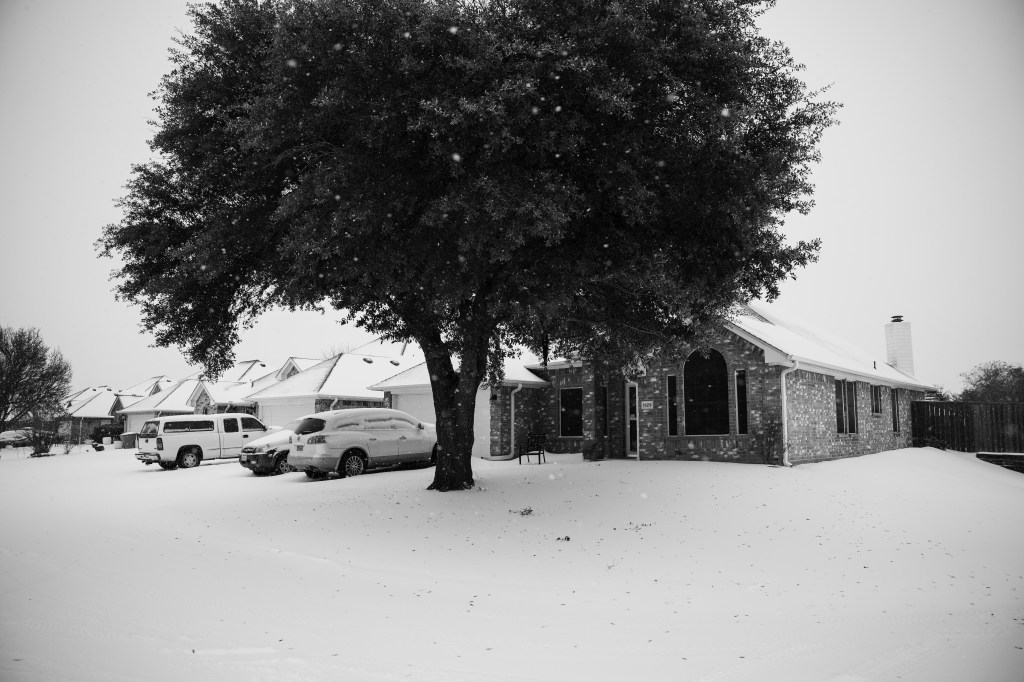
Today is very cold. As I write this it is 10 degrees outside1. Even here in Texas we get a day or two of ice and snow and even sub-zero wind chills each winter, and today is that day.
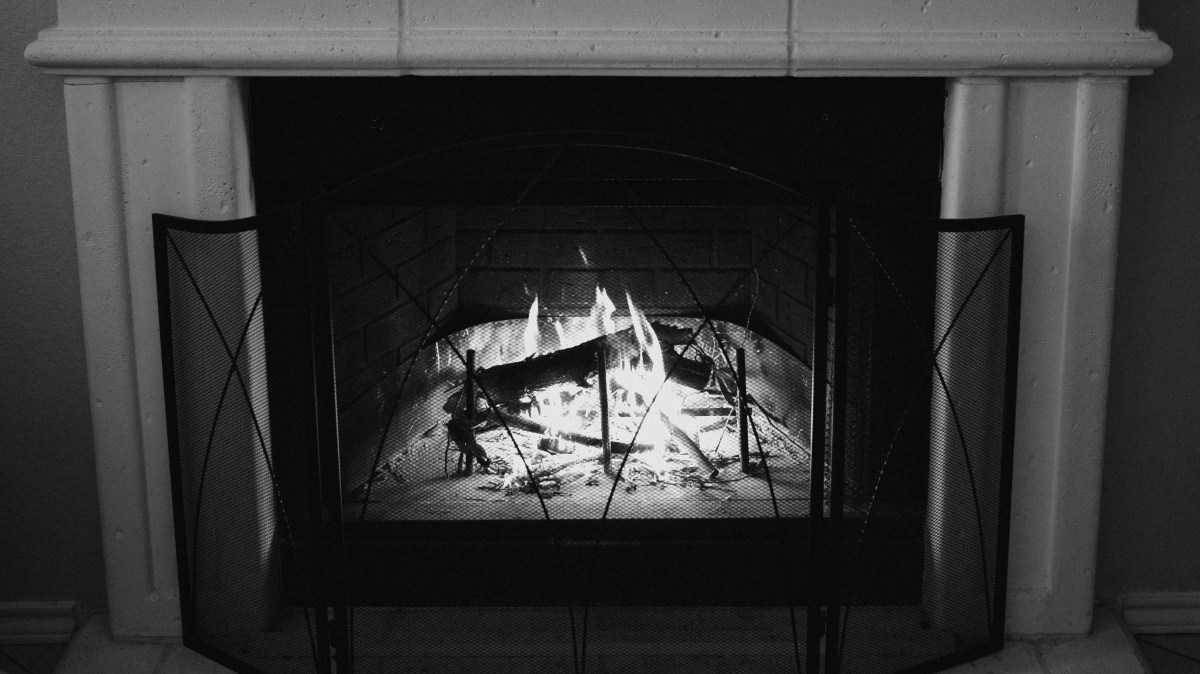
Our house has a small wood-burning fireplace, so just before the ice blew in, I took some time to cut down a few branches which have been hanging a little too low for a little too long from the large live oak out front. The branches don’t burn easily because they are still a little too green, but nevertheless, it is satisfying to burn wood cut yourself from your own resources, even if it is a single tree branch in a single lot of a suburban neighborhood.
It puts me in mind of an old poem by Alexander Pope:
“
Happy the man whose wish and care
A few paternal acres bound,
Content to breathe his native air,
In his own ground.
Whose herds with milk, whose fields with bread,
Whose flocks supply him with attire,
Whose trees in summer yield him shade,
In winter fire.
[ . . . ]
— Ode on solitude
It also puts me in mind of a story, if it can be called that, by Nathaniel Hawthorne which I recently stumbled across.
Hawthorne wrote this piece in 1843 before collecting it into a book of short stories called Mosses from an Old Manse in 1846, although I hesitate to call this particular entry a “story,” it is something more akin to an essay, and, if I wanted to be poetic about it—which I do—I might even be tempted to call it a eulogistic lament. But, whatever it is, it is titled “Fire-Worship” and the premise is well understood from the first two sentences:
“
It is a great revolution in social and domestic life, and no less so in the life of a secluded student, this almost universal exchange of the open fireplace for the cheerless and ungenial stove. On such a morning as now lowers around our old gray parsonage, I miss the bright face of my ancient friend, who was wont to dance upon the hearth and play the part of more familiar sunshine.
Apparently the early nineteenth century saw a great many innovations in domestic heating and cooking in the form of cast iron stoves of various kinds which left little need in most homes for an open fire in either the kitchen or the living room.
As someone who is also interested in the “revolutions of social and domestic life” which we see daily brought about by our own modern inventions, I think “Fire-Worship” is a fascinating portrait of a poetic mind grappling with the things we lose when we reinvent fundamental aspects of society through technology.
By the end of “Fire-Worship”, I think Hawthorne sums up his conception of this loss with the Latin mantra “pro aris et focis,” which colloquially has come to mean “for hearth and home” but which literally translates to “for the altars and the hearths.” While he is literally talking about the fireplace, if we remember that Hawthorne was a poet accustomed to speaking on several levels at once, then, without taking too many liberties, I think we can find in his use of this ancient rallying cry a framework for approaching similar social revolutions in our own day.
Pro focis
Hawthorne’s explicit concern is for the role that the fireplace plays in the ways that people gather and commune together, especially when it is needed most, specifically, in the wintertime.
The word “focis” is the Latin word for fireplace in plural, and you may have noticed that in singular it gives us the English word “focus,” which means—to us moderns as well as to the Romans—the convergence point or center, that is, a point of concentration.
The majority of “Fire-Worship” paints a picture of the daily life of an old clergyman in his study to illustrate the way the hearth embodies all of these meanings. In the morning he sits down by the fire with his books to begin a session of focused concentration.
“
He reads while the heat warps the stiff covers of the volume; he writes without numbness either in his heart or fingers; and, with unstinted hand, he throws fresh sticks of wood upon the fire.
Later, a parishioner enters from the cold and warms himself by the generosity of the host and the heat of the hearth.
“
We lose much of the enjoyment of fireside heat without such an opportunity of marking its genial effect upon those who have been looking the inclement weather in the face.
And at the end of the day, the minister’s family converges in the study for a time of rest and relaxation.
“
At eventide, probably, the study was peopled with the clergyman’s wife and family, and children tumbled themselves upon the hearth-rug, and grave puss sat with her back to the fire, or gazed, with a semblance of human meditation, into its fervid depths.
After drawing these picturesque visions of the effect the hearth has on social interaction, the poet turns prophet and predicts the tragic trajectory of a society without such an effective focal point.
“
It is my belief that social intercourse cannot long continue what it has been, now that we have subtracted from it so important and vivifying an element as firelight. The effects will be more perceptible on our children and the generations that shall succeed them than on ourselves, the mechanism of whose life may remain unchanged, though its spirit be far other than it was.
[ . . . ]
There will be nothing to attract these poor children to one centre. They will never behold one another through that peculiar medium of vision the ruddy gleam of blazing wood or bituminous coal—which gives the human spirit so deep an insight into its fellows and melts all humanity into one cordial heart of hearts. Domestic life, if it may still be termed domestic, will seek its separate corners, and never gather itself into groups. The easy gossip; the merry yet unambitious Jest; the life-like, practical discussion of real matters in a casual way; the soul of truth which is so often incarnated in a simple fireside word,—will disappear from earth. Conversation will contract the air of debate, and all mortal intercourse be chilled with a fatal frost.
Now, in case that hasn’t started to strike a chord yet, there is a very uncanny resemblance between these passages and an anecdote relayed by William Powers in his 2010 book, Hamlet’s Blackberry:
“
I’d seen this phenomenon so often in my own family life, I’d given it a name—the Vanishing Family Trick. We’re all together in the living room after dinner, the three of us plus two cats and a dog, enjoying one another’s company [ . . . ] In the winter we move the furniture closer to the fireplace, so it’s even cozier. It’s a natural place to hang out.
Here’s what happens next: Somebody excuses themselves for a bathroom visit or a glass of water and doesn’t return. Five minutes later, another of us exits on a similarly mundane excuse along the lines of “I have to check something.” The third, now alone, soon follows, leaving just the animals, who, if they can think about such things, must be wondering what suddenly became of a splendid gathering that had barely gotten under way. Where have all the humans gone?
To their screens, of course.
This anecdote seems trite now, but it should be remembered that Hamlet’s Blackberry came out sixteen years ago and was among the vanguard of smartphone-era tech criticism.
And more than that, the triteness is the point. The example sounds familiar because it is familiar.
What the fireplace—the focus—represents to Hawthorne is a point that brings clarity and community and helps people to endure the winters and hardships of life, together. What the technology of the stove represents is a device which provides dispersed and individual warmth. We are seeing these same dispersions and scatterings of our mental and social foci today.
As Nicholas Carr points out in his book The Shallows (also from 2010):
“
Our use of the internet involves many paradoxes, but the one that promises to have the greatest long-term influence over how we think is this one: the net seizes our attention only to scatter it. We focus intensively on the medium itself, on the flickering screen, but we’re distracted by the medium’s rapid fire delivery of competing messages and stimuli.
But beyond the dissipation of our mental focus, the individual nature of devices like laptops and smartphones, not to mention VR/AR, erodes our social connectedness when not kept in check.
And guess what? The tech companies know this. And you can tell they know it, because of how much time they spend trying to convince you otherwise. When you start paying attention, you’ll notice the great lengths to which these companies will go to come up with use cases which indicate that these devices of isolation are actually a better, or sometimes even the only way to truly connect with each other.
This is nothing new. Again, Powers addressed this exact issue over a decade and a half ago:
“
There’s a school of thought that says this is just fine, because digital screens are actually bringing families together. “Technology is enabling new forms of family connectedness that revolve around remote cell phone interactions and communal internet experiences,” concluded a study by the Pew Internet & American Life Project, part of the nonprofit Pew Research Center. The study maintained that having multiple computers in one home “does not necessarily lead family members to be in their own isolated technological corners.” Rather, it found “many instances where two or more family members go online together, or one calls another over to ‘look at this!’”
In other words, the Vanishing Family Trick is even more amazing than it appears. Like the illusionist’s lady who disappears from a black box only to materialize on a silken rope lowered from above, the family that disperses at the call of the screen winds up reuniting in a completely different location—on the screen itself! The more we vanish from the fireplace, the closer we become.
But it’s not true.
And we know it’s not true. We don’t need William Powers or Nicholas Carr2 to tell us it’s not true. We have all experienced it. Anyone who says otherwise is, quite evidently, selling something.
Technically our screens do keep us connected, but they are—to quote Tolkien (of which, more later)—“improved means to deteriorated ends.” Exchanging in-person interaction for its digital counterpart is the modern day equivalent of “thrusting into an iron prison” the fire of our human connection.
“
These barren and tedious eccentricities are all that the air-tight stove can bestow in exchange for the invaluable moral influences which we have lost by our desertion of the open fireplace. Alas! is this world so very bright that we can afford to choke up such a domestic fountain of gladsomeness, and sit down by its darkened source without being conscious of a gloom?
When we let technology transform and “trample upon” our focal points—our common places of convergence and solitary methods of concentration—we lose each other, ourselves, and our best earthly fortification against the raging winter of the world.
Post Script
I have more to say about the first part of our “pro aris et focis” mantra, but this article is getting much longer and more involved than I originally expected, so I’m going to break it into two parts. This will also make sense because the remainder of what I would like to discuss in relation to “Fire-Worship” differs pretty significantly in nature to that which is addressed in this post.
Thanks for reading and stay tuned for the rest!
- Okay, so I began this article several days ago when the snow started, but it has taken longer than expected to complete. By the time I’m publishing this, about a week later, the wintery mix has all but melted away . . . Welcome to Texas. ↩︎
- or Paul Kingsnorth, or Jonathan Haidt, or Byung-Chul Han, or Cal Newport, or Neil Postman, or Marshall McLuhan, or Lewis Mumford, or Jacques Ellul, etc, etc, etc. ↩︎