the content mint newsletter
Fresh insights for creating valuable media
considerations for small businesses and professionals who want to create worth-the-while content
In the newsletter you’ll find:
- a value-based media and communication philosophy
- DIY content creation and curation ideas
- responses to fellow readers
- and other quick thoughts on art, communication, and business
Not an email person?
READ AS ARTICLES
The ARCHIVE:
-
articulation (n.)
◆
1 minuteREAD POST
Media is communication, and effective communication often comes down to articulation.
I like the word articulation because it means both “to clearly express a thought” and “to be united by a joint, particularly in a way that bends or rotates.”
Although I don’t think this is technically accurate, I like to combine these ideas into something like:
articulation (n.)
The ability to wrap one’s thoughts and expressions around a concept or idea in a way that helps oneself or others grasp it better.So . . .
What concepts can you articulate through your media in a way that will help your audience better understand?
-
affordances
◆
2 minutesREAD POST
In his 1988 book, The Design of Everyday Things, Donald Norman discusses an idea known as affordances. As he describes:
“
The term affordance refers to . . . those fundamental properties that determine just how [a] thing could possibly be used. . . . Affordances provide strong clues to the operations of things. Plates are for pushing. Knobs are for turning. Slots are for inserting things into. Balls are for throwing or bouncing. When affordances are taken advantage of, the user knows what to do just by looking: no picture, label, or instruction needed.
Building on this idea with an example, in his 2019 book, Alchemy: The Surprising Power of Ideas That Don’t Make Sense, Rory Sutherland describes the creation of Sony’s Walkman in the 80s:
“
The request for the Walkman had initially come from the 70-year-old [Masaru] Ibuka [one of the founders of Sony], who wanted a small device to allow him to listen to full-length operas on flights between Tokyo and the US.
When the engineers came back, they were especially proud. Not only had they succeeded in achieving what Morita had briefed them to create – a miniature stereo cassette player – they had also managed to include a recording function. . . . but according to multiple accounts, Morita vetoed the recording button. . . . In the same way that McDonald’s omitted cutlery from its restaurants to make it obvious how you were supposed to eat its hamburgers, by removing the recording function from Walkmans, Sony produced a product that had a lower range of functionality, but a far greater potential to a change behaviour.On a device like a Walkman, the inclusion or exclusion of specific buttons would naturally have a dramatic impact on how the device was used, and, further, how it was perceived by potential customers. Now the customer base is only those who would like to listen to music, which makes it easier to market and easier to make a purchasing decision if that’s what you’re looking for.
The mediums we choose to present our content in are similarly designed with various types of affordances. What can I click? Where do I look next? Where does this button go? But that doesn’t mean that every possible affordance must be made available to the audience. Only the ones that your specific customer base finds valuable.
So, how can you design and engineer the medium of your content in a way that maximizes its usefulness and impact for your customers?
-
a moment for LinkedIn
◆
2 minutesREAD POST
Let’s take a look at one more social media platform that we haven’t discussed yet: LinkedIn.
According to the Metricool study I referenced yesterday, it looks like LinkedIn is having a bit of a moment, with increases in all metrics that they analyzed over last year (except for a decline in posting frequency).

The impressions seem to be lower than YouTube, which I think means the algorithm doesn’t spread the content quite as far (YouTube’s “Recommended” feature probably helps a ton in this respect), but those who do see your content are very likely to interact with it.
It’s also very interesting that the clicks rate is so high compared to last year. According to LinkedIn:
“
Clicks – Shows the number of clicks on your content, company name, or logo by a signed in member. This doesn’t include interactions, such as reposts, reactions, and comments.
I think this has to do with the nature of LinkedIn as still being a place to connect and learn more about the people and businesses in your network, while many other “social” platforms these days seem to be more about consuming content from strangers than connecting with actual people.
(Although, I do wonder if clicking the “see more…” link on posts gets counted as a click, because I think that might skew the numbers due to the fact that there is so little above-the-fold content available on any given post without clicking “more…”)
But, as a medium, LinkedIn is an interesting chimera right now, part blog/newsletter, part microblog/spontaneous thinking, part life updates—with photo carousels, videos, and even document sharing thrown in for good measure. I haven’t fully formed a complete idea of where it fits in the posting vs publishing schema yet, but I’ll be sure to post more in the future as I consider further.
If you have your own experiences or insights about LinkedIn, I’d love to hear about it!
-
top of the content funnel
◆
1 minuteREAD POST
As promised last week, I want to share a couple of observations from Metricool’s 2025 Social Media Study which has some interesting data on two platforms which were not analyzed in the previous social media study I wrote about, namely YouTube and LinkedIn. Today, let’s look at YouTube.
According to Metricool, YouTube has highest impression rate per follower and the highest interaction rate per follower of all the platforms they looked at1. By a large margin. And they specifically highlighted that this is consistent across accounts from less that 2,000 followers up to 50,000 followers.
What does that mean?
In the first place, it means is that the YouTube algorithm is really good at getting your content out in front of people. If your content is being seen by 15x the number of followers you have, chances are those impressions are coming from well beyond just your follower base.

In the second place, it means that people on YouTube aren’t shy about reacting to content.
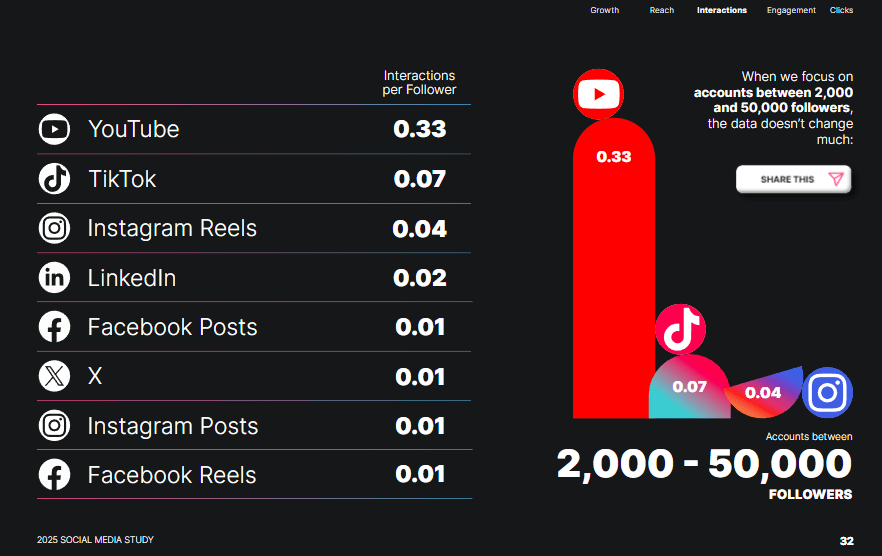
Those two elements combined are why Metricool puts YouTube at the very top of its social media funnel:

Add to this the idea that YouTube content requires some amount of value forethought and the medium has a strong archival bent, and I think YouTube becomes one of the most prominent platforms for delivering valuable content, specifically in the audio/video format.
- For some quick definitions: impressions are how many times any content shows up on someone’s feed, even if it’s the same person’s multiple times, while interactions are anytime content is expanded, liked, commented on, or otherwise directly reacted to. ↩︎
-
posting platform or publishing platform
◆
1 minuteREAD POST
To continue our recent exploration of what it means to think of your content as a “publication,” I want to bring it down to the platform level.
I recently came across a study by the social media analytics and management company Metricool, in which they delved into stats from the following social media platforms:
Pinterest, Twitch, Instagram, X, Facebook, TikTok, LinkedIn, and YouTube
Next week I’ll probably dig into my takeaway from the actual data, but today I mostly want to consider the above list of social media platforms, mainly because I think one of them doesn’t belong.
Every one of those platforms, save one, is designed to streamline the distribution of unprepared content, i.e. content which can be posted as soon as it’s thought of.
Of course, you can always prepare your content via your own self-discipline and artificial standards, but of the above list, only one platform carries an intrinsic standard of some form of editing/pruning/preparing.
That platform is YouTube.
I consider YouTube to be far more of a publication platform than a social media platform. In terms of the primary way the medium is used, I would say YouTube is to TikTok what Substack is to X, and clearly Substack was not considered a social media platform for purposes of this study (or at least not substantial enough of one to be included).
As I said, we’ll explore what the study has to say about YouTube next week, but for now, I’d love to hear any thoughts you have about the difference between posting and publishing (even if you don’t care and don’t see a difference either way). Feel free to hit reply and let me know!
-
managing waste
◆
1 minuteREAD POST
Believe it or not, I’ve actually been trying to develop one single line of thought over the last week and a half’s worth of posts. Let’s see if we can tie it all together, in reverse order:
Motifs are patterns which set expectations. Those expectations define what is in, what is out, and what is next.
Branding is a system of motifs that communicates to customers whether what they want is inside or outside of that branded offering.
These branding motifs should extend beyond visual presentation through to your ideological patterning.
The act of preparing content is the act of removing all the things (visual and ideological) that are extraneous to the branding motifs of your business or offering.
This preparation reduces wasted time by setting expectations properly, generating positive emotional experiences, and accurately directing customers toward something they will find valuable (and maybe away from something they wont).
Systematizing this preparation can elevate your content from mere posting to something which we could begin to consider publishing.
The more visible your publishing standards are, the more credible your content tends to be for your audience, because it shows that time and care has been taken in advance to do the waste management for them.
-
pattern and emotion
◆
1 minuteREAD POST
Yesterday I wrote:
“
motifs almost always carry an emotional component to them.
It was one of those statements that, after I wrote it, I had to stop and consider, “wait, can I actually back that up?” I think I can. Here’s my line of reasoning:
Motifs are defined by repetition, which inherently makes them a form of pattern, and patterns—as anyone teaching them to a toddler can tell you—are all about the building of expectations.
Let’s do an experiment. What follows next in this pattern?
A A A __
If you said A, you’re wrong. It’s actually B.
Okay . . . so what comes after A A A B __?
If you said B, you’re wrong again. It’s actually A.
Alright, I’ll give you the rest of the pattern now:
A A A B A C A D A E A F A G A . . .
Ah, now you can figure it out. Feels good right? And it feels even better if I tell you that the next in sequence is, indeed, H.
Phew.
This is how motifs and patterns are tied to emotion. Thwarted expectations produce negative emotion, while realized expectations produce positive emotion.
So . . . what emotions are produced by the brand motifs of your business or the patterns of your content?
-
branded content
◆
1 minuteREAD POST
Sometimes, when our content provides a very pointed form of value, it can be helpful to build a distinct motif system which will unify that content separately from the rest of the business. In other words, brand the content.
Here are a handful of benefits of branded content:
maintain focus
Well-branded content can help keep your focus on the primary value you are providing each time you go to create something new.
set expectations
Branding helps others quickly get an idea of what they can expect to gain from your content. If you have complicated or nested content system, it can also help the audience navigate the to the particular value they are looking for.
develop tone
Motifs almost always carry an emotional component to them, so developing a brand system that conveys the tone you want the content to carry can help ensure the message of the content carries the same tone. (Which makes sense because we already know that the entire environment of the content is the message.)
~ ~ ~
All that being said, what branding ultimately does is set up guardrails for value. It creates a motif system which delineates what is in and what is out according to the proposed value associated with that system.
For those of us who are trying to maximize the value and minimize the waste in our content, these guardrails can be very useful tools.
-
motifs
◆
1 minuteREAD POST
All art (and, in a sense, all life) is established on motifs.
A motif is simply a single element which is used repeatedly to establish connections between things and form a sense of unity between them.
The form of repeated arches or pillars in a cathedral, big bad wolves and evil step-mothers in fairy tales, and the association of the musical “baaa dum!” with the shark in Jaws are all examples of motifs.
Meanwhile, in the world of business, the systematic application of motifs goes by another name: branding.
Typically these branding motifs are visual: logos, colors, fonts, etc.
But motifs can just as easily be based in ideas and concepts as in sight and sound cues.
So, beyond your brand’s design playbook, what are the recurring ideological and conceptual motifs that could be found throughout your content?
I would venture to say it’s worth hashing those out just as carefully as you choose acceptable heading and paragraph fonts.
-
content marketing vs marketing your content
◆
1 minuteREAD POST
As we saw a few days ago, the final stage of the publishing process is marketing.
Marketing is what you do to point people towards something they might find valuable.
Content is one way to achieve this “pointing.” This is commonly referred to as content marketing.
When the primary value of a piece of content is raising awareness of value to be found elsewhere, around here we say that it has “extrinsic value.” On the other hand, when content has value in-and-of itself, we call that “intrinsic value.”
But, if your content does possess intrinsic value, you might eventually find that you need more content dedicated to “point” to that value extrinsically.
This is essentially the difference between “content marketing” and “publishing,” the former markets something else, while the latter needs its own marketing.

