the content mint newsletter
Fresh insights for creating valuable media
considerations for small businesses and professionals who want to create worth-the-while content
In the newsletter you’ll find:
- a value-based media and communication philosophy
- DIY content creation and curation ideas
- responses to fellow readers
- and other quick thoughts on art, communication, and business
Not an email person?
READ AS ARTICLES
The ARCHIVE:
-
“content marketing” is not a strategy
◆
1 minuteREAD POST
“Content marketing” is not a strategy because it doesn’t have an objective.
“We need to create content because everyone else is creating content” is not a sufficient motivational statement to help you make the real tactical decisions that will come when you begin to think about what kind of content you actually want to make.
Before you can create any kind of worthwhile content, you have to figure out why creating content is the best approach for your business in to begin with.
And here’s the key:
The best content strategy doesn’t start with why you should create content.
(Usually that just comes down to: “because I want more customers.”)Rather, the best content strategy starts with why your customer should want to consume your content in the first place.
If you can figure that out, you’ll be more motivated to make the content, and customers will be more excited to engage with it.
-
the shelf life of content
◆
1 minuteREAD POST
When you consider the context of your media, one thing you’ll have to decide implicitly or explicitly is “how long will this content be relevant?”
For example, if you are simply communicating the details of an event which will be over in a month, then you want it to be top of mind for that month and then it can get lost in the internet ether, no problem.
But if you are communicating the core mission of your business, you probably want that to be presented in a form that will last much longer.
This brings us back to the idea that context informs form.
If the context of your communication is social media, then, by nature of that context, it will have a pretty short shelf life, regardless of what form it takes (video, image, text, etc).
However, you also have the option to combine a circular communication approach with a little-q (high-quantity) output strategy.
On the other hand, if the context will be more static, like the homepage of your website, you can plan a longer shelf-life for a single piece of content, in which case maybe a big-Q (high-quality) and linear communication approach is best.
When you start to get the hang of how context and form impact the effect and application of your media, you can get creative with your communication strategy, and the best part is, you’ll know the why behind those creative decisions.
-
the small business disadvantage
◆
2 minutesREAD POST
As we saw yesterday, small businesses have an advantage over large corporations in two areas: unique offerings and personal connection.
But where they have to fight a little harder is for trust.
The simple fact of brand recognition can often be enough to establish trust and credibility for a national organization, but small businesses often don’t get that benefit of the doubt. Instead, the ability to make a personal connection with customers is the small business’ biggest advantage when it comes to trust building.
Here are a handful of ways that small businesses can communicate trust through their media (in order of least to most effective, in my opinion):
personality / vibes
This is the implied strategy in a lot of social media content that I come across. It can be useful for “clicking” with people who are naturally drawn to people like you, but it doesn’t necessarily translate into customers, more likely it translates into consumers of entertainment value.
demonstrate knowledge / technique
This doesn’t convince the customer that you can solve their problem necessarily, but it does show that you know what you’re doing.
offer something of value to the potential customer
This is my favorite method because it puts you in the position of initiating a mutual value transaction by being the first to offer an open hand. Bonus points if what you’re offering through your content can be put to use right away.
demonstrate vulnerability / start a dialogue
This one is tricky because you don’t want to come across as needy, but a true authenticity that makes the customer feel like they are as influential in your success as you are in theirs can be a powerful emotional connection. If you are able to open an actual two-way communication with the prospective customer, then you have drawn them out of the status of simple content consumer and begun a real relationship.
~ ~ ~
If you can effectively implement one or more of these techniques in your content, especially in the early stages of the buying cycle, then you are well on your way to overcoming the biggest disadvantage of the small business.
~ ~ ~
P.S. This list is not exhaustive. What other methods can you think of or have you seen to be effective? I’d love to hear your thoughts!
-
the small business advantage
◆
1 minuteREAD POST
When customers are choosing between a small business and an established brand for similar products or services, the burden of proof often lies on the small business to differentiate themselves meaningfully from the established brand.
As I see it, there are two major factors in favor of the small business:
- the uniqueness of the offering
- this can increase value
- the personal connection to the customer
- this can increase trust
Not every small business will be able to rely on both factors, but the faster and more strongly a small business can communicate at least one of them in the mind of the customer, the better their chances are.
So . . .
If you look at your website, how long would it take to identify a personal connection to your business or a uniquely beneficial quality of your offering?
~ ~ ~
P.S. Notice that price is not included as a differentiating factor. Small businesses often can’t compete for price—nor should they have to. Taking advantage of the uniqueness and/or personality factor can help maintain or even increase your prices in the face of competition.
- the uniqueness of the offering
-
leave something out
◆
1 minuteREAD POST
“Engagement” is a hot topic when it comes to digital content, but there is one aspect of engagement that I hardly ever see addressed:
Incompleteness.
Part of the dynamics of media operates this way:
The more information is provided to you, the more passive the media consumption experience is.
The more is left out, the more participatory, or engaging, the experience becomes because the audience is forced to “fill-in” the gaps themselves.
Consider watching a film vs reading a book.
When watching a film, both the story and the creative, imaginative elements are provided for you, which makes it a very passive, sit-back-and-relax kind of experience.
On the other hand, a book is more of a lean-in kind of experience because you have to fill in the gaps between the ideas represented in the words and the implied reality. (Not to mention the manual engagement of physically turning the pages as opposed to a film which plays all the way through on its own.)
For one more example, consider watching a video on a topic you are interested in, and the person speaking leaves out a point that you think is very important. You are much more likely to feel the need to respond in some way and fill that gap than if every point was sufficiently touched on.
This principle applies in many other situations as well, so think of ways you can intentionally leave something out to make your content more engaging.
~ ~ ~
P.S. If you want to read more about this idea, Marshall McLuhan codified it with his discussion of “hot” and “cold” media in his book Understanding Media.
-
authenticity is free
◆
1 minuteREAD POST
When you start producing content, especially if you want to be taken seriously, it can be intimidating to think of all the things you need to have or learn in order to have adequate production value.
But when you don’t have production value, what you do have is authenticity, because what you’re producing and showing is the way things actually are, not the way you’ve designed them to appear.
Here’s a clip of Linus from Linus Media Group, which operates several of the largest tech content channels on YouTube, talking about the transition from recording at home to having a dedicated studio space:
watch clip (56s) >>
Interestingly, what Linus calls “production value” in the clip I think would be more accurately termed “authenticity.” But, in the world of YouTube, authenticity is the primary measure of production value.
Here’s a graph I sketched that I think represents what Linus is gesturing at in the clip:
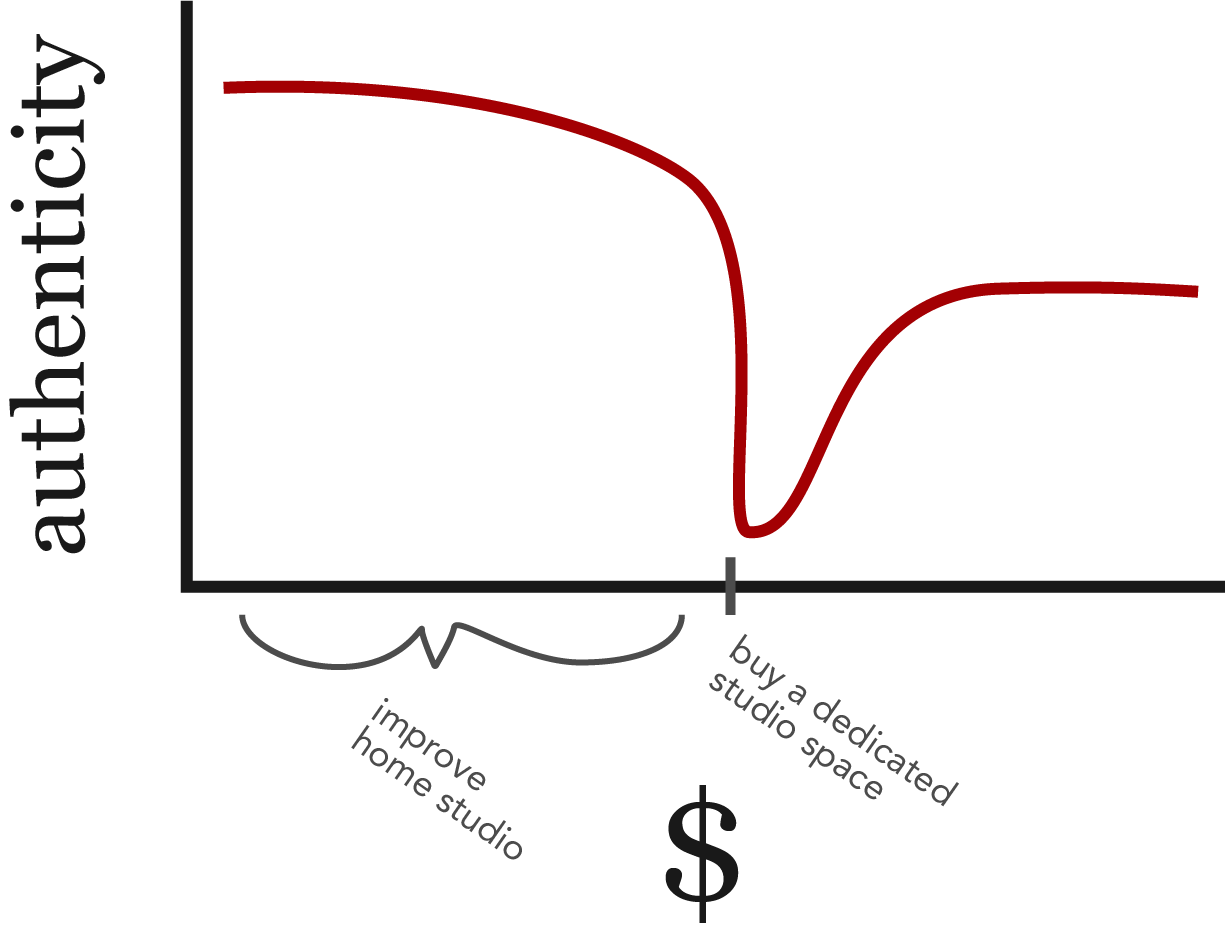
Notice how even after you spend a lot of money to recreate the authenticity that comes for free, you will never completely reach that level again because the new production environment is inherently fabricated.
Now, there is a trust that comes from the establishment of actual production value and a production environment, but I’m not sure that it’s necessarily a greater level of trust than that which comes from real, free authenticity.
And the good news is that right now, with absolutely nothing, you’re already at the peak of the authenticity curve.
So take advantage of it.
-
put to use right away
◆
2 minutesREAD POST
Yesterday I asked about how those content creators that you respect online gained your trust and attention.
I want to highlight this response from a fellow list member named Jared. We were discussing a church media creator and educator that he follows named Brady Shearer, and when I asked how he first discovered the content he said:
“
I think it was a social media video with tips about making videos for church. It was a shorter, 10 minute-ish, video with all kinds of helpful tips that I put into use right away.
(shared with permission, edited for clarity, emphasis mine)
That last part is key: “all kinds of helpful tips that I put into use right away.”
This is a great example of the power of utility value, which I think is probably the most effective form of value for gaining an audience who is primed to become customers. (Which, by the way, Jared has also made purchases from Brady after discovering his content.)
Jared’s experience lines up pretty well with my own, too. When I look at those channels I’ve followed for the longest—and specifically those for which I have become a customer of the actual business—I can trace nearly all of them back to a single moment when I needed the information they were sharing right away, and from there started exploring the rest of what they had to say.
So . . .
What can your content offer to your customers that they can put into use right away?
~ ~ ~
P.S. Jared also mentioned to me that a big part of the reason he continues to follow Brady is because of his perceived authenticity and genuine desire to provide value through his content rather than simply capture value.
-
how’d it get that way?
◆
1 minuteREAD POST
Think of the content creators that you respect the most.
Particularly the ones you feel like you have gotten a lot of personal benefit from.
(Bonus points if you’ve actually become a customer of theirs.)
Now ask yourself, how did it get that way?
How did you find them?
Why did you decide to keep paying attention to their content?
What did they offer that moved you over the edge from content consumer to paying customer?
I’d love to hear your experiences and thoughts if anyone wants to be brave and hit reply!
-
word-of-mouth
◆
1 minuteREAD POST
A lot of small businesses rely on word-of-mouth to get new business.
But relying on word-of-mouth can sometimes be like a game of telephone.
What people think you do doesn’t always perfectly align with what you actually offer. (This is more true the more specialized you are at what you do.)
When that happens you can end up spending unnecessary time explaining what you do and don’t do for unqualified leads.
So . . .
You can keep relying on word-of-mouth and hope that enough of the right people find you.
Or you can start publishing content and be your own word-of-mouth.
-
random DIY content creation tips, vol. 2
◆
1 minuteREAD POST
Here are a few more tips to help you get started creating content in your medium of choice:
video/photo
- avoid having your subject directly against a wall, if you are able to add depth to the shot in any way it will usually make it more interesting
- having the subject closer to the camera and farther from the background is a natural way to add depth-of-field, which is what portrait mode on your phone imitates
~ ~ ~
audio podcasting
- if you buy a microphone, learn if it’s directional or omnidirectional
- if it’s directional, make sure it’s pointed at your mouth, not the ceiling
- on a similar note, make sure you maintain a consistent distance between your mouth and the microphone during recording or else you may have a lot of variance in the volume levels and sound quality
~ ~ ~
video editing
- Jump cuts are okay, especially if it’s a fairly informal video style. It can be tempting to add a transition like a cross dissolve to cover jump cuts, but that usually just makes it more noticeable.
- If you really want to cover up a jump cut, here are two pro-moves:
- Punch-in (i.e. zoom the shot in about 20%)
- This also gives you a second cover because you can zoom back out at the next jump cut.
- Cut away to something else and then come back
- This is very helpful for covering up a series of jump cuts fairly close together.
- Punch-in (i.e. zoom the shot in about 20%)
Check out the previous set of tips here.
Was this helpful? Want more like this? Have questions? Let me know!
- avoid having your subject directly against a wall, if you are able to add depth to the shot in any way it will usually make it more interesting

