the content mint newsletter

Fresh insights for creating valuable media


it’s for people who believe content should be
worth-the-while


ARCHIVE:

  • a tale of two economies

    READ POST

    When we start creating content, we are de facto engaging in the modern “attention economy,” but as small businesses, first and foremost we operate in the actual economy.

    The distinction may seem minor, but it’s worth pointing out because many of the trendy modern content creation techniques are designed specifically and exclusively to benefit the attention economy.

    (The idea of trends itself is a distinct feature of the attention economy which is not of universal benefit in the actual economy.)

    The good news is that you own a business, which means that (ideally) you are not fully dependent on your content to keep the lights on. So, unlike professional content creators who are compelled to play the game and chase the algorithm, you can create content that is dedicated to providing value to your customers, without resorting to tactics designed to capture and mine as much attention from the general population as possible.


  • auteur theory

    READ POST

    In film studies, there’s a concept known as auteur theory, which is the idea that the best film directors function in a similar way for their films as an author does for a book.

    The auteur has the vision for the final product of the film and control over every aspect of the production to shape the final product to fit that vision.

    Not every film is helmed by an auteur, but those that are bear the unique fingerprint and perspective of that person in every detail.

    You are the auteur of your business.

    Does your content bear the marks of the distinct vision and perspective that motivated you to go into business in the first place?


  • who gets the value?

    READ POST

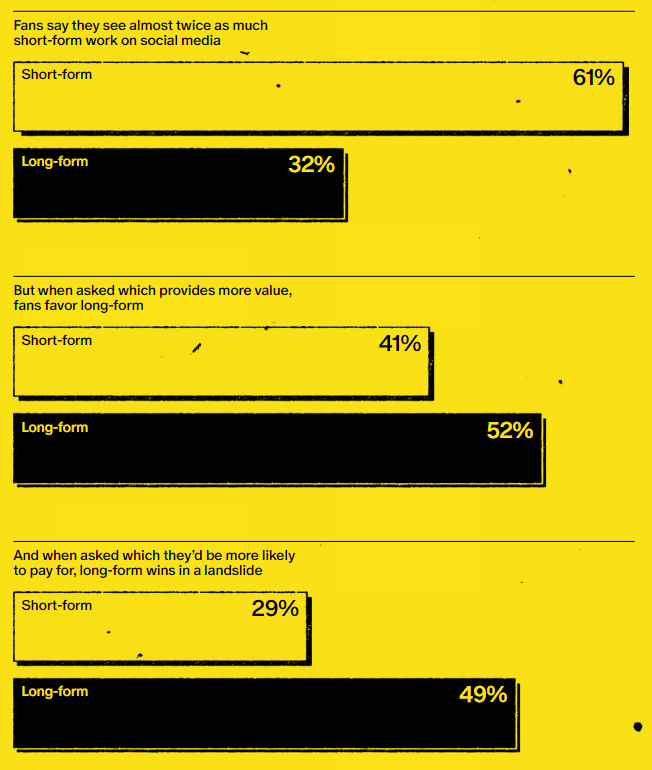
    At the beginning of this year, Patreon released a document they called the State of Create which breaks down the current trends and feelings of online content creators and their fans. The whole document is pretty interesting, but I want to highlight one specific set of statistics here.

    According to the 2K+ fans that were surveyed:

    Here’s the thing . . .

    As the rest of the document goes on to explain, short-form content creates value for the social media platforms because the platform uses it—divorced from the feed of the actual creators—to keep audience attention focused on suggested and “For You” feeds instead.

    But where audiences find value is in well-thought-out long-form content from creators they intentionally follow.

    So . . .

    When you’re creating content, ask yourself: For whom am I providing value?


  • dress for the job you want

    READ POST

    The media that you choose to create and display should represent the most ideal version of what you want your business to be.

    It should represent the kinds of customers you want.

    The kinds of work you want to be known for.

    And the way you want to be perceived.

    Your media is more than just a resumé.

    It’s also a prophecy.


  • everyone else

    READ POST

    If the extent of your marketing strategy is to create content “because everyone else is creating content . . .”

    . . . then when it comes to what kind of content you want to create . . .

    . . . the only thing you’ll be able to think of is what “everyone else” is doing.

    Which means your content will look just like everyone else’s.


  • re: price buyers

    READ POST

    In response to my message last week in which I said that you can have fun with your media for price buyers, a fellow list member named Randall shared this anecdote:

    There was a good example of this on a billboard in Frisco about 20 years ago. The ad was for Goodfellows, an upscale furniture store down Preston near Campbell in Richardson. It had a picture of some nice furniture with the words:

    “Goodfellows: Expensive furniture for rich people.”

    (shared with permission)

    That’s a great example of targeting a specific buyer type and quickly identifying the key information they’re looking for.

    Not to mention putting a billboard in Frisco at that time is also a great example of intentionally crafting the proper context for your media as well.

    So, how can you form and position your content so that your ideal buyers feel like you know exactly who they are and what they want to know about you?


  • final thoughts on buyer types

    READ POST

    Matching your content to your customers is about two things:

    1. quickly and clearly communicating the specific critical information that each customer is looking for to make their purchase decision (price, value, action, personality)
    2. making the customer feel seen in their specific state of mind during the buying process

    But since people are never one buyer type exclusively, and your customers will be a mix of buyers to begin with, it’s important to have a mix of content that speaks to more than one of the buyer types.

    If you rely too heavily on tactics for one buyer type, you risk alienating others. People who just want to see your smiling face will be turned off if all you’re posting about is promos and deals.

    The key to communicating to various buyer types is to tailor your content to the customers who will be seeing it in any given context. So, for example, maybe the content which details your offering on your website is developed with value buyers in mind, while your social media content is developed with a view toward relationship buyers.

    Finally, don’t forget to balance the scales.

    If we were to plot the buyer types on a scale from emotional decision makers to intellectual decision makers, relationship and convenience buyers would be toward the emotional end of the spectrum, while price and value buyers would be at the intellect end. So be sure to add a little emotional weight into your content for the latter and some intellectual weight to the former.


  • content for relationship buyers

    READ POST

    Relationship buyers are your fans. They love you, they love what you do, they want to support you, and they want other people to know about you.

    This type of customer is pretty common among small businesses because the face of the owner is usually pretty closely tied to the name of the business, which means the owner’s friends become a natural network of relationship buyers.

    Another example would be local haunts like bars, coffeeshops, bookshops, etc., which are the type of experience offerings that people become regulars of, i.e. they make it their “spot.”

    These type of buyers—with at least one caveat1—are probably going to be your followers online. People who want to keep up with what you’re doing and show off their support via your branding or merch, or even organic UGC.

    The easiest way to engage with these buyers through your media is to use your business’ social media content the same way you would use your personal social media. And frankly, it seems like this is what most small businesses default to because it feels the most natural.

    But if we really took the time to sit down and think about what kind of content would actually benefit these loyal customers, I think we could be a lot more creative in the way we approach this natural followership than just posting about how adorable the office dog is or which account manager recently had a birthday.

    Relationship buyers want to spend their attention on you.

    Let’s respect their investment.

    1. There is a subset of relationship buyers that I would call “status-quo buyers.” These are people like dental patients. The patient is committed to their dentist and returns because they are satisfied with the relationship they have, but, for the most part, they’re not super interested in what’s happening at the dental office in the six months between their regular appointments.
      If you really want to engage these buyers on a regular basis, you’re going to need to create content that has an outsized amount of intrinsic value for the audience. ↩︎

  • content for convenience buyers

    READ POST

    Convenience buyers need a solution quickly, and they don’t want to have to jump through a lot of hoops to get it.

    When it comes to your content for these buyers, there should be a pretty direct line between consuming the content and making a purchase.

    Bonus points if your content is able to even half-way solve their problem through its intrinsic value, leaving only the really technical or on-going support solution for you to accomplish with your offering.

    Ultimately, if you know you’re creating content for convenience buyers, you should express:

    1. an understanding of the situation that the buyer is in
    2. how you can help them
    3. and how they can take advantage of that help

    And if you know exactly what the situation is that will have them looking for your solution in the first place, you’ll also be able to tailor the context of your content to target exactly the right people.

    For a real-world example, just consider that this is basically the entire strategy of personal injury lawyers. If your audience is convenience buyers, you can probably take a few notes and adapt a few of those tactics to your situation, but maybe adjust the tone to match how you want to be perceived.


  • content for value buyers

    READ POST

    Value buyers don’t care so much about price as they do about what they get for the price.

    They need to feel that they’re getting the most bang-for-their-buck, regardless of how many bucks they actually end up spending.

    So when you start to create media for value buyers, you’re going to want to showcase as much of your offering as you can in as much detail as you can. They’re going to binge all this content and mentally tally up the intangible value that they expect to receive for their investment.

    Value buyers practically live in the guided discovery phase, so you want to make it a good experience with lots to explore. This is also a good opportunity to create a media environment with as little noise as possible so they can focus on just your offering without comparing it to the value they might get from anything else.

    Just remember when you’re describing your offering to go beyond the nuts and bolts and tie everything back to the big picture of how your offering can make the customer’s life better.

    That’s the real value they’re looking for, and they’re willing to pay accordingly.


Prefer long form?

READ AS ARTICLES