the content mint archive
every email from the newsletter in one place
-
generative AI is bad for credibility
◆
2 minutesREAD POST
This is not a value-judgement, it is a statement, an observation of the way things are; albeit based on my personal experience and anecdotal evidence.
In the world right now there are lots of people on both sides of the A.I. emotion spectrum; some people are excited about the possibilities, and some people absolutely despise what A.I. represents from a philosophical standpoint.
What this means is that if you create content which is detectibly A.I. generated, some people will see it as a matter of course, while others will have a moderate-to-severely lowered opinion of your business1. Since neither of these represents an increase in esteem2, this leaves your brand impression at a net negative.
I think this consideration will be most relevant to those whose target market consists largely of creatives, and those trying to market themselves with some form of thought-leadership-style content.
In the first place, creatives tend to be among the most affronted by A.I. on an existential level, which means leaning into it will not gain you any good-will with that segment, rather the reverse.
In the second place, if a large part of your offering is built on your personal insights, then any indication that some part of those insights are A.I. generated will cast a pall of doubt over your entire output and, more importantly, your ability to deliver what you claim to offer (i.e. your thinking). It’s like playing Scrabble online with someone that you caught using Scrabble Word Finder once—for the rest of the game you’re never quite sure how authentic their moves are.
But in any case, the worst thing you can do for your credibility is to try to pass off A.I. generated content as human-generated. So if you’re going to use A.I., be honest3 (i.e. authentic), but also make sure you have a clear idea of how it will affect your customers’ perception of your business.
- I have been surprised at the number of people who are unaware of the viscerally negative reaction that many people have to the use of A.I. (which is part of the reason for this post). I’d say much more people are excited to create content with A.I. than anyone is to consume A.I. created content, but that may be a topic for a different post. ↩︎
- The only way for a use of generative A.I. to create an improved impression is if either A.I. is an integral part of your offering to begin with and/or you can manage to create something truly unique and valuable with it—which, if you’re simply using it for the sake of your own speed, cost, and convenience, is unlikely. ↩︎
- The disclosure of A.I. is becoming more common and people are developing interesting methods of doing so, for instance this A.I. contribution scale by Blair Enns. By that scale, this post—and every post in this newsletter—is AI-0. ↩︎

-
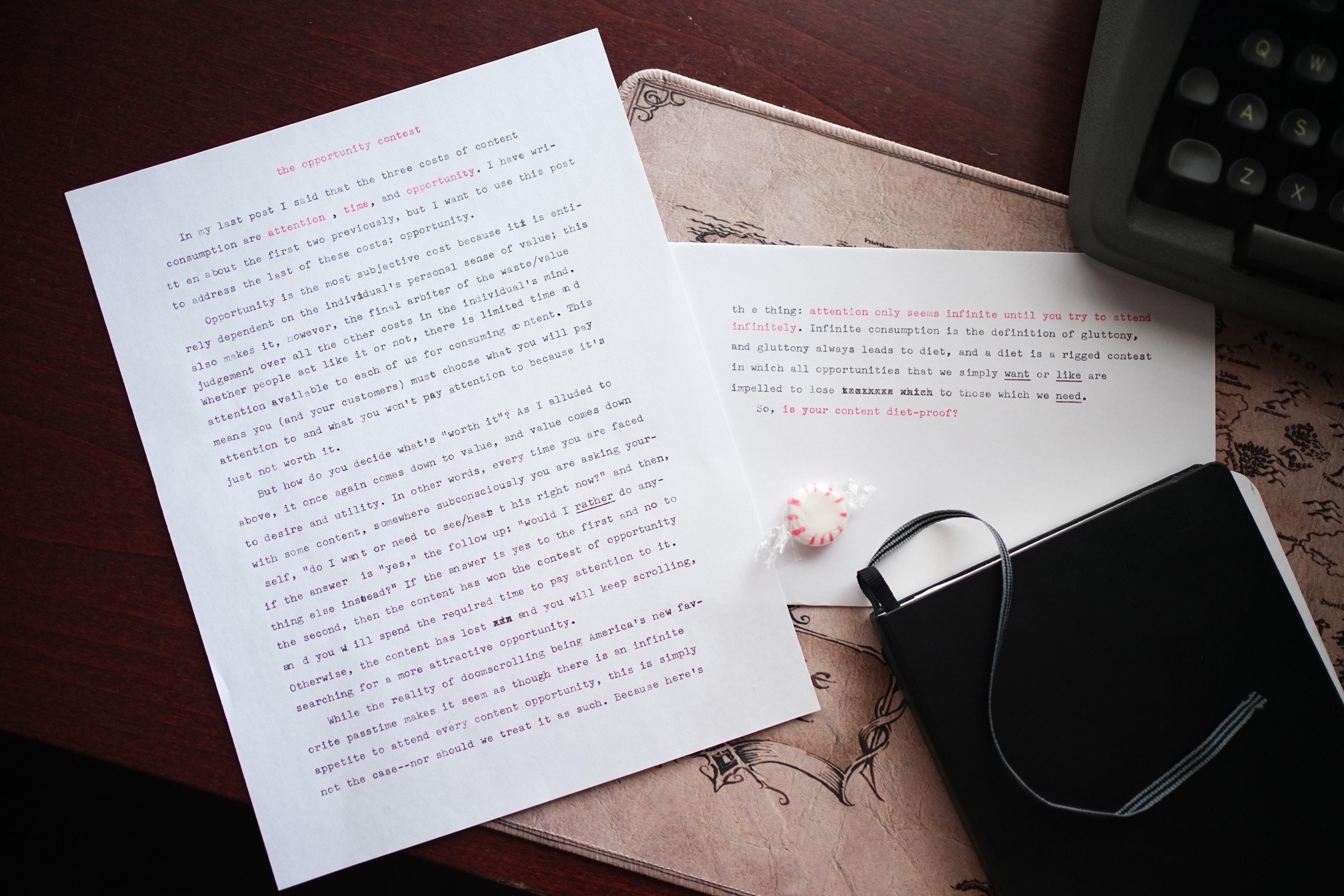
the opportunity contest
◆
2 minutesREAD POST
In my last post I said that the three costs of content consumption are attention, time, and opportunity. I have written about the first two previously, but I want to use this post to address the last of these costs: opportunity.
Opportunity is the most subjective cost because it is entirely dependent on the individual’s personal sense of value; this also makes it, however, the final arbiter of the waste/value judgement over all the other costs in the individual’s mind. Whether people act like it or not, there is limited time and attention available to each of us for consuming content. This means you (and your customers) must choose what you will pay attention to and what you won’t.
But how do you decide?
As I alluded to above, it once again comes down to value, and value comes down to desire and utility. In other words, every time you are faced with some content, somewhere subconsciously you are asking yourself:
“Do I want or need to see/hear this right now?”1
And then, if the answer is “yes,” the follow up:
“Do I want or need to do anything else instead?”2
If the answer is “yes” to the first and “no” to the second, then the content has won the contest of opportunity and you will spend the time required to pay attention to it. Otherwise, the content has lost and you will keep scrolling, searching for a more attractive opportunity.
While the reality of doomscrolling as America’s new favorite pastime makes it seem as though every person has an infinite appetite to attend every content opportunity, this is simply not the case—nor should we treat it as such.
Because here’s the thing:
Attention only seems infinite until you try to attend infinitely.
Afterall, infinite consumption is the definition of gluttony.
And gluttony will always lead to diet.
And a diet is a rigged contest in which all opportunities that we simply want or like are impelled to lose to those which we need.
So . . .
Is your content diet-proof?
- this establishes that it may offer something of value to you ↩︎
- this weighs the value of this opportunity against the potential value of all other opportunities ↩︎
click to enlarge
-
paying attention
◆
1 minuteREAD POST
I’ve written before about the time-cost of content, but time is not the only cost associated with consuming content.
If I were to lay out a more complete picture of this time-for-content exchange, it would probably look something like this:
content costs attention
attention costs time
time costs opportunityOf these three costs — opportunity, time, and attention — attention is maybe the most important. I really don’t think that many people consider seriously enough the implications of asking others to pay attention to their content. After all, attention is the raw material which makes up our very experience of existence.
In her 2009 book Rapt: Attention and the Focused Life, Winifred Gallagher puts it this way:
“
If you could look backwards at your years thus far, you’d see that your life has been fashioned by what you’ve paid attention to and what you haven’t. You’d observe that of the myriad sights and sounds, thoughts and feelings that you could have focused on, you selected a relative few, which became what you’ve confidently called “reality.” You’d also be struck by the fact that if you had paid attention to other things, your reality and your life would be very different.
Seen in this light, I think everyone who creates content would have a much different idea of the responsibility that comes with asking others for attention.1
One way to be conscientious about this reality is to ask yourself when you begin to create content:
“How do I want people to be different after they experience my content?”
Because people will be different after they experience your content.
- there is also responsibility associated with the paying of attention, but that is not the issue at hand ↩︎

click to enlarge
-
the right to forget
◆
1 minuteREAD POST
If you stop playing algorithm games and just let people forget about you, the only ones who won’t are the ones who can’t.
And the ones who can’t are the ones who really want or need what you’re offering.
And if they really want or need what you offer, they will probably pay money for it.
And why would you waste your time creating content for anyone else?
-
cold (call) content
◆
1 minuteREAD POST
No one likes cold calls, or cold emails. Telemarketers and email-blasters are almost universally blocked by default on caller ID systems and email spam filters. Even sales people dislike cold marketing because the efficacy is notoriously low. The most creative and successful sales people avoid it altogether when they can help it.
So why do so many people use their content marketing as just a shinier version of cold outreach?
With the shift to algorithmically-driven feeds (rather than the former era of user-chosen-subscription feeds), modern common wisdom says to blast social platforms with content every day (or more1) for those who will accidentally stumble across your content with zero context, and if a post goes viral enough or if you post enough volume, maybe you can get a tiny fraction of those new eyeballs to turn into paying customers.
But the internet has far greater advantages than the ability to exponentially increase the scale of the worst possible sales tactic (i.e. spamming).
If you instead choose to focus your content on your warm market—those who are already customers or have an expressed interest in your offering—then you can strengthen the bond with people much more likely to spend money with you in the first place, and the public arena of publishing platforms like YouTube means that a cold audience can eavesdrop on your conversation with your warm audience and then decide on their own terms whether or not they want to be part of that conversation as well.
-
from stumblers to seekers
◆
1 minuteREAD POST
What would it look like if, rather than hoping that a good customer might stumble across your content on their feed, your content was so intrinsically valuable that your ideal customer was impelled to seek it out on its own terms?
-
AI fatigue
◆
1 minuteREAD POST
The other day I was on the website of a local small business which provides a technical expertise service and I found an article on their blog about “AI fatigue.”
The article explained how the AI hype is wearing out and companies are re-hiring human specialists to provide more value to customers.
And then it pulled its punches at the end by concluding with a point about how the “smarter model” is using the combined power of humans and AI together to provide improvements in both innovation and efficiency (which we know is counter productive based on the innoficiency principle).
My initial reaction was that this is a somewhat milquetoast take, but, by that same token it’s hard to argue too strongly with since it doesn’t really have a hard stance one way or the other.
Then I noticed something. There was a disclaimer at the bottom of the article.
The article was produced by an “article aggregator” service.
That’s right. An article about AI fatigue which starts by explaining how everyone is sick of AI and ends by defending AI’s place in your workflow, was literally written by AI.
I could say more about this particular version of content farming, but for now, here’s the point:
AI fatigue is real and AI content farming is making it worse.
If you really want to be viewed as an expert in your field, you need to speak in your own voice. It is the only way to be both clear and authentic.
It used to be the only way to create content.
Now it’s a hit of oxygen in a stagnating bog of recycled and regurgitated slop.
-
content questions for the new year
◆
1 minuteREAD POST
- What value does my content provide to my audience/customers?
- How much time am I asking people to spend on my content?
- Is the value worth the time?
- How much time am I spending on my content?
- If I stopped posting content entirely, would there be any noticeable change in business?
- Is my offering or ability to deliver my offering improving as a result of the content I’m creating?
And, finally:
- Does my content make people better?
- If so, how?
- Otherwise, why not?
-
offerings and outfits
◆
1 minuteREAD POST
If your content directly provides some kind of value to your audience or customers, then it is an offering of your business, and ought to be treated as such.
If your content is not primarily concerned with providing value to customers directly, then it is something you do for yourself.
It becomes a series of bright flashy lights all about you and your business. The first visual signal of who you are to new customers.
An outfit, if you will.
In that case, make sure that the way you dress matches the way you want to be perceived.
So . . .
Is your content something you do for yourself, or for your customers?
-
it depends
◆
1 minuteREAD POST
The amount of pressure you feel to create social media content is usually directly tied to how much you feel like you depend on social media to bring in new customers.
So, if you feel a lot of pressure to post on social media, ask yourself, has your social media been a dependable source of leads?
Maybe it has been—great!
But if not, maybe it’s time to find something else to depend on.
If you don’t depend primarily on social media to bring in new customers, then *phew* the pressure’s off!
When that’s the case, you can take a step back and think about more impactful approaches to your content without feeling that tinge of desperation tied to every half-baked post that goes on your feed.

Prefer long form?

