the content mint newsletter
Fresh insights for creating valuable media
considerations for small businesses and professionals who want to create worth-the-while content
In the newsletter you’ll find:
- a value-based media and communication philosophy
- DIY content creation and curation ideas
- responses to fellow readers
- and other quick thoughts on art, communication, and business
Not an email person?
READ AS ARTICLES
The ARCHIVE:
-
AI fatigue
◆
1 minuteREAD POST
The other day I was on the website of a local small business which provides a technical expertise service and I found an article on their blog about “AI fatigue.”
The article explained how the AI hype is wearing out and companies are re-hiring human specialists to provide more value to customers.
And then it pulled its punches at the end by concluding with a point about how the “smarter model” is using the combined power of humans and AI together to provide improvements in both innovation and efficiency (which we know is counter productive based on the innoficiency principle).
My initial reaction was that this is a somewhat milquetoast take, but, by that same token it’s hard to argue too strongly with since it doesn’t really have a hard stance one way or the other.
Then I noticed something. There was a disclaimer at the bottom of the article.
The article was produced by an “article aggregator” service.
That’s right. An article about AI fatigue which starts by explaining how everyone is sick of AI and ends by defending AI’s place in your workflow, was literally written by AI.
I could say more about this particular version of content farming, but for now, here’s the point:
AI fatigue is real and AI content farming is making it worse.
If you really want to be viewed as an expert in your field, you need to speak in your own voice. It is the only way to be both clear and authentic.
It used to be the only way to create content.
Now it’s a hit of oxygen in a stagnating bog of recycled and regurgitated slop.
-
content questions for the new year
◆
1 minuteREAD POST
- What value does my content provide to my audience/customers?
- How much time am I asking people to spend on my content?
- Is the value worth the time?
- How much time am I spending on my content?
- If I stopped posting content entirely, would there be any noticeable change in business?
- Is my offering or ability to deliver my offering improving as a result of the content I’m creating?
And, finally:
- Does my content make people better?
- If so, how?
- Otherwise, why not?
-
offerings and outfits
◆
1 minuteREAD POST
If your content directly provides some kind of value to your audience or customers, then it is an offering of your business, and ought to be treated as such.
If your content is not primarily concerned with providing value to customers directly, then it is something you do for yourself.
It becomes a series of bright flashy lights all about you and your business. The first visual signal of who you are to new customers.
An outfit, if you will.
In that case, make sure that the way you dress matches the way you want to be perceived.
So . . .
Is your content something you do for yourself, or for your customers?
-
it depends
◆
1 minuteREAD POST
The amount of pressure you feel to create social media content is usually directly tied to how much you feel like you depend on social media to bring in new customers.
So, if you feel a lot of pressure to post on social media, ask yourself, has your social media been a dependable source of leads?
Maybe it has been—great!
But if not, maybe it’s time to find something else to depend on.
If you don’t depend primarily on social media to bring in new customers, then *phew* the pressure’s off!
When that’s the case, you can take a step back and think about more impactful approaches to your content without feeling that tinge of desperation tied to every half-baked post that goes on your feed.
-
Now . . . This
◆
3 minutesREAD POST
Hello friends,
This is a slightly different kind of post. It’s one of those good(ish) news/bad(ish) news kinds of things. (It’s also probably longer than most of you need, so TL;DR at the end.)
The bad(ish) news is that this will no longer be a daily newsletter. I started the content mint over the summer for a handful of reasons, one of which was to force myself to start blogging in some form—which I had intended to do for many years. Another reason was to solidify some of my ideas related to what it means to create worthwhile content in the current internet landscape and publish them in a place where my prospective video production clients could glimpse my thought process before beginning a project with me.
While I believe I have accomplished both of those goals, I have also discovered a couple of downsides to writing a specialized daily newsletter—namely, that it is specialized and daily. In the first place, a daily newsletter must, by nature, be quite concise for the sake of both the author and audience, but I’ve found that, like Pascal, I don’t everyday have the time to make it properly concise. In the second place, the time that it does take to write every day leaves me little extra time to write about other things that interest me but which fall outside the scope I established for this newsletter, i.e. content marketing and media communication for small businesses.
The final consideration is my audience, y’all. There are less than a dozen of you on the list and nearly every one of you I know personally. According to my stats, every one of you open my emails almost every day, which I very much appreciate, but at the same time, since I know you all, I know that the majority of you aren’t creating business content—you just know me and want to know what I’m up to.
So that brings me to the good(ish) news, which is that I am starting a new blog that will not be daily or specialized. It will just be updates on things that I’m thinking about or doing whenever I deem that they are interesting enough to write about. You know, how blogs used to be.
As an indication of the sporadic nature of the content, I’m calling the new blog: Now . . . This.
If you are one of the few subscribers who don’t know me too well yet (thank you especially for subscribing!), you can expect writing on this new blog to be related to film, literature, communication, and technology, mixed in with armchair philosophy and maybe even some original fiction, who knows. I currently have a handful of Christmas-related posts I will be trying to release in the next week or so. (Working titles include: “Home Alone and the Fear of the Unknown”, “The Most Important Character in A Christmas Carol”, and “A Grimm Tale to Read at Christmastime”.)
In the interest of not wasting your time in case you aren’t interested in the same myriad of things I am, you will not be automatically subscribed to the new blog. Which is to say, you’ll need to manually subscribe to the new content here, if you so choose. Alternately, just know that it exists and feel free to check in periodically without letting it assert itself into your consciousness (or inbox) through push notifications. Whatever you like.
Again, I appreciate you all for your daily attention over the past several months. I don’t expect the content mint to go away entirely; anytime I have something to share which falls in the category of business media, you’ll still get an email from this list, just not every day.
So with that, I’ll wish you all a Merry Christmas, a Happy New Year, and, in case I don’t see you, good afternoon, good evening, and good night.
~ Jonathan
primum non tempus perdere
-
top-of-mind
◆
2 minutesREAD POST
If you create content primarily to stay “top-of-mind” for people, here are two questions to consider:
QUESTION 1
Are there any environmental cues related to your offering that naturally make you “top-of-mind” at the right time?
For example, I know I am going to see my dentist every six months. I have calendar events and reminders to make it “top-of-mind” only when it’s almost time for my appointment. And if I need to see my dentist outside of those appointed times, then the pain in my mouth or my self-consciousness about the stains on my teeth will prompt me to go in early.
Once I have chosen a dentist, assuming I am happy with the service, I probably don’t need to follow them for weekly posts reminding me that they exist.
So instead of creating regular low-value content designed to stay top-of-mind, my dentist can focus on creating more intermittent content that may be more highly valuable in specific dental situations.
QUESTION 2
Does the value of your content fluctuate over time?
For example, if I am struggling with my financial situation, I may decide to consume content from a financial advisor who is creating valuable content to help me shape my mindset around how I handle my money.
If I still can’t wrap my head (or behaviors) around the concepts in the advisor’s content, I’ll probably hire him or her to personally help me.
But, eventually, I will hopefully get a pretty good grasp on my situation and stabilize my immediate crisis, at which point there is diminishing returns on the value that I was getting from the advisor’s content at the beginning.
However, if I am following said advisor, continuing to receive content in my feed means I will still be spending time on the content even though I’ve significantly diminished the ROI.
On the other hand, if I found the content on a website and maybe binged through a library of helpful topics, I may forget about the advisor once my crisis is over.
And that’s okay.
Because if someone can forget you, they don’t really need your offering.
It’s those who can’t forget you, even unprompted by a social feed, who will be your best customers.
In other words, forgetting is vetting.
~ ~ ~
All that to say, if you’re spending a lot of effort on content trying to stay top-of-mind for customers who don’t immediately need your offering, you’re probably wasting their time (and your own).
But the good news is, with a little consideration, you can almost certainly redirect those content efforts to create something even more valuable.
-
what people want
◆
1 minuteREAD POST
When people are on social media, they don’t want to be lectured to about your product or service. What they want is news or entertainment. You may be able to get them to politely sit through a lecture about your offering, if you are able to present that lecture as either news or entertainment1, but that doesn’t mean they care about your solution beyond the vague emotional texture it adds to their daily scrolling (which, as we know, almost invariably ends in a net negative).
However, when people are on your website, it means they actually want, and maybe even need, whatever it is you offer. Otherwise they wouldn’t go out of their way to find you and learn more.
So, for which of those audiences are you more concerned about when creating your content?
- You may also get them to sit through your lecture if it is an interruption to their news and entertainment in form of an ad, but people generally don’t like their entertainment interrupted and they don’t like to be sold to, so you’re fighting an uphill battle for goodwill in that respect. ↩︎
-
balderdash and you
◆
1 minuteREAD POST
There’s a classic board game called Balderdash wherein one player holds a card with an extremely obscure, but real, word and its definition.
The goal of the other players is to write down definitions for this word which sound like they could be associated with the word to try to fool the other players into voting for theirs as the correct answer.
In case you were unaware, this is (simplistically) how AI LLM systems like ChatGPT work. They scour their language database and mountains of internet metadata to provide responses to questions which sound like they could be the right answer, but in reality they have no way of knowing how accurate it is, although they do a pretty good job of getting pretty close, most of the time.
So, while everyone else is getting could be answers to their questions via AI and trying to figure out how accurate it might be, your job, expert, is to show the card with the real definition on it.
-
see and show the details
◆
1 minuteREAD POST
Yesterday we looked at the value, and even excess value, that can be generated by highly technical educational content.
What makes that content so valuable though?
The details.
In a digital world designed to make the creation of extemporaneous and surface-level content as quick and easy as possible, those who take the time to see and show the details are a breath of fresh air, and that makes people pay attention.
As Sherlock Holmes puts it:
“
There’s nothing so important as trifles.
-
so good they pay attention
◆
1 minuteREAD POST
There is something inherently interesting about watching someone who knows what they’re doing explain something in precise detail.
This can be so interesting, in fact, that it can attract attention even if the educational information being presented is not immediately (or even potentially) relevant.
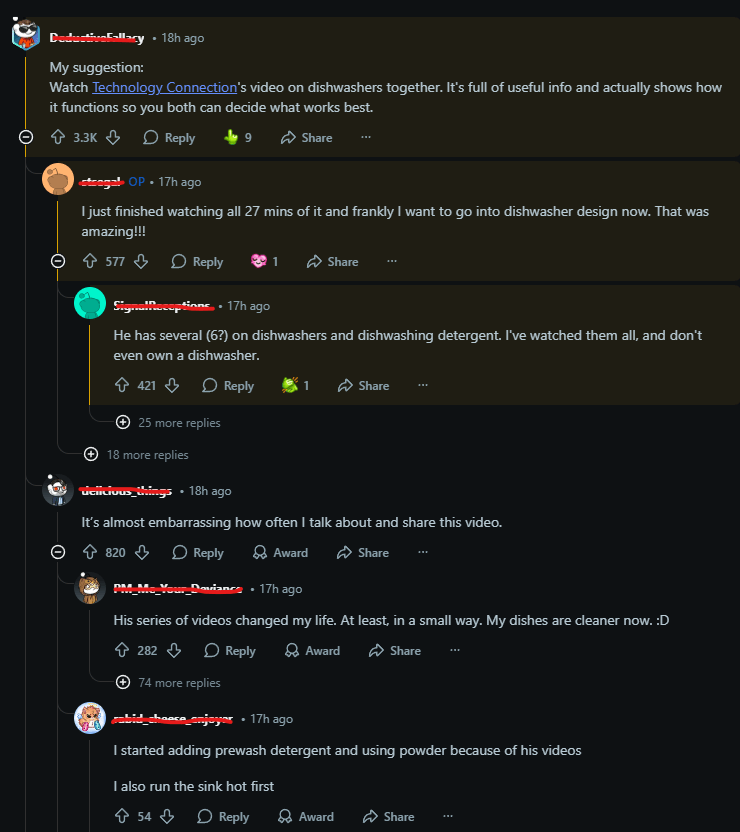
To illustrate, I’ve collected a handful of examples of highly technical long-form content which people have attested to watching, despite the irrelevance of the subject:
From The Beginner’s Guide To Latte Art* – 40 minutes

From Your dishwasher is better than you think (tips, tricks, and how they work)** – 27 minutes

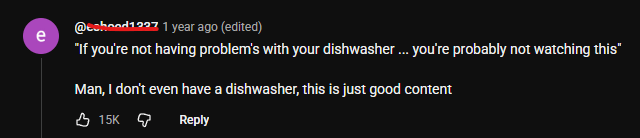

From World’s Most Advanced Video Editing Tutorial (Premiere Pro) – 4 hours 19 minutes


~ ~ ~
So, expert, what is it that you know so well you could explain it in a way that makes people pay attention, even if they don’t really care?
* – To be fair, this channel is very personality-driven, meaning those inclined to learn about the overall topic (coffee) are more likely to watch videos like this one which may not be specifically relevant.
** – This is one of four videos on dishwashers from this channel. All (except the one mentioned above) are over a half hour long and all have similar comments. In fact, comments like this for these videos are so prevalent they have spilled over into Reddit and I started wondering if it was some kind of running gag I wasn’t aware of. I still don’t know, you tell me.