the content mint newsletter
Fresh insights for creating valuable media
considerations for small businesses and professionals who want to create worth-the-while content
In the newsletter you’ll find:
- a value-based media and communication philosophy
- DIY content creation and curation ideas
- responses to fellow readers
- and other quick thoughts on art, communication, and business
Not an email person?
READ AS ARTICLES
The ARCHIVE:
-
depth and breadth
◆
1 minuteREAD POST
If you know what you’re doing, and you want to prove it to your customers or prospects through your media, then you need to provide an idea of the range of your knowledge in your area of specialization.
This can be done along two dimensions: depth or breadth.
Depth is like a microscope, it involves zooming in to the details and inner workings of your particular industry or discipline.
Breadth, on the other hand, is more of a satellite view, a zoomed out look at how your particular area of focus interrelates to other disciplines or industries.
The more you are able to demonstrate a grasp of your industry in each of these dimensions, the stronger your credibility will be when new customers discover you.
-
dream client
◆
1 minuteREAD POST
Imagine a seemingly unattainable dream client or customer.
One with the deepest pockets.
The most impressive status and network.
The highest appreciation for the value of your offering.
Got it?
Now, imagine this client is binging all of your business content.
Every channel.
Every feed.
Every post.
Would they be impressed?
-
the flip
◆
1 minuteREAD POST
I recently read the book The Four Conversations by selling and pricing expert Blair Enns, whom I have quoted before.
In the book, Enns discusses what he calls “The Flip.”
“
The Flip is the name we give to the moment in time when…we move from being viewed as a vendor with numerous competitors and little power in the relationship to being recognized as the expert who possesses few equals and therefore considerable power in the relationship.
But here’s the key, The Flip should happen without you present. It happens as a result of the value you provide through your content.
“
It is a conversation that happens through our agents of thought leadership and referrers. It is a function of our reputation preceding us…Through these [educational] activities we prove our expertise by giving it away, allowing clients to judge for themselves whether or not we are the experts we claim to be.
So . . .
If you make a claim of expertise or specialization, how is your content substantiating that claim such that your customers don’t require any further convincing by the time they first reach out to you?
-
the law of transformation
◆
1 minuteREAD POST
There is a law of economic value which we might summarize this way:
as transformation increases, so does the value potential
Thus a cake is more valuable than the combined price of the eggs, flour, and sugar that make it up.
In a similar way, your content can become more valuable if you are able to combine various bits of diverse information or media into a new form.
Combining ideas in novel or unexpected ways can lead to new insights, while even just transforming text into an audio or visual format—or vice versa—can provide accessibility to a new audience.
Here are a few examples of what this could look like, in order from less transformative to more transformative:
- Translating one raw form into another (e.g. reading a text article directly into an audio format)
- Gathering various items together and condensing them into one (e.g. a listicle)
- Taking one or more items and adding to them ideas or content of your own generation (e.g. an opinion article or video essay)
So, in what way can you take the various raw media materials related to your offering or industry and transform them through your content into something of even greater value for your customers?
-
what does it mean?
◆
1 minuteREAD POST
Yesterday I found myself on the Merriam-Webster website, and in the sidebar I saw that a very interesting word was trending.
The word was:
ChargoggagoggmanchauggauggagoggchaubunagungamauggSo, curiosity piqued, I clicked to see the definition, which is:
lake on the border with Connecticut in south central Massachusetts
Okay, great . . . That tells me what it is, but I clicked on the word because it’s unique; I wanted to know why it’s called that. How did it get that name, and what does it mean?
But for that info I realized I needed an encyclopedia, so on the Encyclopedia Britannica page for Lake Chargoggagoggmanchauggauggagoggchaubunagungamaugg I learned that:
“
The lake’s name is reportedly Algonquian for what popular culture has held to mean “You fish on your side; I fish on my side; nobody fishes in the middle,” although there is evidence that this interpretation was fabricated by a local news correspondent in the early 20th century.
Voila, all my questions answered.
Here’s the thing . . .
If you have a unique offering, people don’t just want to know what you do, they want to know why you do it in your unique way, how it got to be that way, and what it means to you (which they can then translate into what it means for them).
And the best way to answer those questions is to develop your content to function like an encyclopedia, and not simply as a dictionary.
-
the social-last marketing strategy
◆
2 minutesREAD POST
Over the past decade or so, the marketing vogue has been what is sometimes called a social-first marketing strategy. This involves directing the majority of marketing efforts toward creating content specifically designed to perform well on social media platforms.
But as more people start to reconsider their relationship with social media—and social media’s relationship to culture at large—let’s remember that social media is only one tool in the marketing toolbox, not the whole arsenal.
Depending on how you want to be perceived as a business and content creator, you could even decide to adopt what we might call the social-last marketing strategy.
The social-last strategy involves first and foremost publishing content in the medium and context in which it can provide the most value to your audience (as opposed to forcing content to fit the mold of current trends), and then using social media primarily as a top-of-funnel awareness generator which points people to where your really valuable content can be found.
What this does is twofold:
First, it respects people’s time. If you are among the growing number of those who are personally trying to spend less time on social media, why would you ask your customers to spend more time there on your content?
Second, it allows you to build a focused content environment which is free from the noise that comes from social media feeds. If you can direct customers to a channel or webpage that is filled exclusively with you, then they’re no longer comparing you to another similar business that they’re likely going to see the next time they swipe the screen.
I’m not saying this strategy is necessarily superior to the social-first method, I just want to make sure we’re allowing ourselves to think outside the box and make strategic decisions because they make sense for our business and not just because it’s what everyone else is doing.
-
vicarious experience
◆
1 minuteREAD POST
One of the most effective qualities of content, especially the visual mediums, is that it is able to convey the feeling of experiencing your product or service before the customer actually experiences it. This is what I call “vicarious experience.”
This is super useful in a lot of situations. For example, if you had to get a root canal and were very nervous about it, it would probably be helpful for you to see a video of the endodontist’s office to get a feeling of who the doctor is and what it will be like to go in for the procedure before you get there.1
In this case, the vicarious experience is able to alleviate fear associated with a necessary but undesirable service.
On the other hand, if you are planning a day at an amusement park, the vicarious experience of seeing people having fun on the rides might heighten your excitement and anticipation for being on the ride yourself.
In this case, the vicarious experience increases desire for the real experience.
While the subject of your vicarious experience content will obviously be you and your product or service, remember that ultimately this content is about making the customer feel like you understand their hopes and fears before they get to actually experience your offering.
- To see this specific example in action, take a look at my case study from Root Canal Specialists of Baton Rouge. They did a great job of expressing an understanding of the patient’s perspective and fears while alleviating those fears with their warm personalities and patient testimonials. ↩︎
-
a tale of two economies
◆
1 minuteREAD POST
When we start creating content, we are de facto engaging in the modern “attention economy,” but as small businesses, first and foremost we operate in the actual economy.
The distinction may seem minor, but it’s worth pointing out because many of the trendy modern content creation techniques are designed specifically and exclusively to benefit the attention economy.
(The idea of trends itself is a distinct feature of the attention economy which is not of universal benefit in the actual economy.)
The good news is that you own a business, which means that (ideally) you are not fully dependent on your content to keep the lights on. So, unlike professional content creators who are compelled to play the game and chase the algorithm, you can create content that is dedicated to providing value to your customers, without resorting to tactics designed to capture and mine as much attention from the general population as possible.
-
auteur theory
◆
1 minuteREAD POST
In film studies, there’s a concept known as auteur theory, which is the idea that the best film directors function in a similar way for their films as an author does for a book.
The auteur has the vision for the final product of the film and control over every aspect of the production to shape the final product to fit that vision.
Not every film is helmed by an auteur, but those that are bear the unique fingerprint and perspective of that person in every detail.
You are the auteur of your business.
Does your content bear the marks of the distinct vision and perspective that motivated you to go into business in the first place?
-
who gets the value?
◆
1 minuteREAD POST
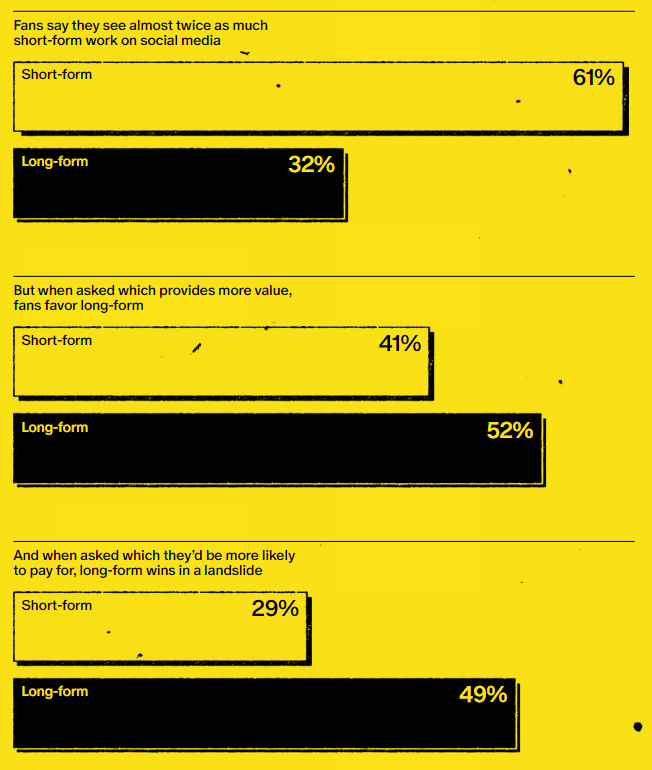
At the beginning of this year, Patreon released a document they called the State of Create which breaks down the current trends and feelings of online content creators and their fans. The whole document is pretty interesting, but I want to highlight one specific set of statistics here.
According to the 2K+ fans that were surveyed:
Here’s the thing . . .
As the rest of the document goes on to explain, short-form content creates value for the social media platforms because the platform uses it—divorced from the feed of the actual creators—to keep audience attention focused on suggested and “For You” feeds instead.
But where audiences find value is in well-thought-out long-form content from creators they intentionally follow.
So . . .
When you’re creating content, ask yourself: For whom am I providing value?

