the content mint archive
every email from the newsletter in one place
-
five years from now
◆
1 minuteREAD POST
Think about what you want your business to be five years from now.
What does this business look like?
What kind of customers does it have?
How do those customers perceive this business?
What is the relationship between that business and its customers?
Now consider . . .
What kind of content would that business be posting?
-
the long game
◆
1 minuteREAD POST
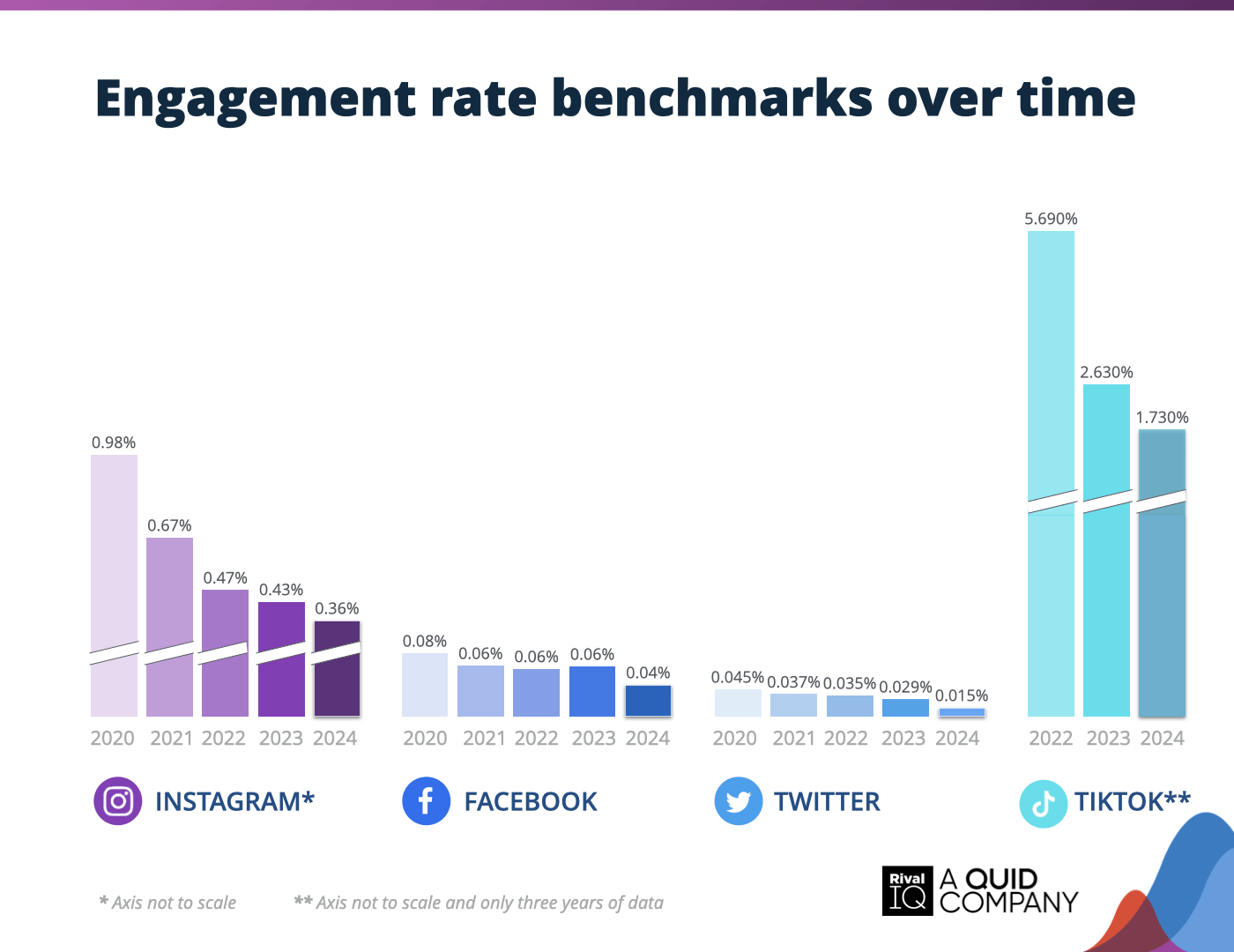
I recently came across a benchmark report by Rival IQ about the state of social media across a variety of industries.
They examined all kinds of statistics related to how frequently businesses in each industry post on the various platforms, what types of posts they create (video, photos, reels, carousels, etc), and which types of posts and hashtags get the most engagement.
But, in my opinion, the most important piece of information came near the beginning of the report:
Engagement rates are dropping year-over-year on all social media platforms across all industries.
So . . .
What’s your long game?
-
random DIY content creation tips, vol. 3
◆
1 minuteREAD POST
audio
Always check your sound with headphones, don’t just rely on your audio meter levels to tell if you’re capturing good sound. The levels will tell you if your audio is in the right volume range, but you won’t be able to determine if there is excess noise or static.
This seems like an obvious tip, but I have come across this problem more than once in the last few weeks, even people who know what they’re doing can get tripped up on it.
~ ~ ~
video
When recording something happening, shoot the same action from multiple perspectives if you have the time and opportunity. For example, if you are recording two people in conversation, you might get these shots:
- a wide shot (shows the two people and surrounding environment)
- a medium shot (both people in frame about waist up)
- and two close ups, one for each person
When you start to edit your clips together you will be able to cut from the wide to the medium to the close ups which will make the action more dynamic and give you more creative options. This tip can also apply to photography.
~ ~ ~
video editing
If you’re looking for a desktop-based video editing software, DaVinci Resolve is a cross-platform, professional-level editing application which makes the majority of its features available in the free version. It’s definitely worth getting to know if you are getting started and want something to grow into.
Want more random DIY content creation tips? Check out vol. 1 and vol. 2
-
how to achieve content consistency
◆
2 minutesREAD POST
It’s all well and good to decide that you should be posting content consistently, but when you’re in the day-to-day of a busy season in your actual work, keeping up the content can be challenging.
So how do you maintain momentum?
Here are a handful of considerations:
make it a habit
The more frequent you make the habit, the less likely you are to drop the ball. This is a daily newsletter because it’s pretty easy to remember that every day I need to post something (although that doesn’t necessarily make the actual content generation any easier, tbh).
self-queue triggers
This would involve thinking of events that happen on a regular basis that you can use to “trigger” you to make new content.
For example, you might decide that every time you get back from a job site you need to post an insight of what you learned or something interesting that happened. That way you don’t have to think about posting content until you’re out in the field and are in a proper context for developing insights.
seasonality
Don’t feel like consistency necessarily means non-stop. You can fluctuate between periods of high- and low-intensity publishing, the key is keeping these period rhythmic and, if not predictable, then at least clearly communicated to the audience when you’re taking a break or start publishing again.
create a content plan
This is the most strategic approach. It means not posting any content for a period of time during which you can decide on a high-level communication goal (say, you want to change your customer mix, so you need your communication to resonate with a new demographic).
Once that goal has been defined, you can plan out the kind of communication you want to develop (form, context, etc) and start gathering the materials (photos, video, graphics, etc) which can be turned into content and more easily posted on a regular schedule, or even scheduled to be posted automatically if it’s all pre-made.
~ ~ ~
The great thing about creating content based on value rather than algorithmic optimization, is that you can take the time to get creative and decide a publishing schedule that makes the most sense for your personal voice and for your offering, without stressing about hitting a quota based on attention-maxing.
-
the value of consistency
◆
1 minuteREAD POST
The traditional wisdom regarding content creation is that you should be posting content with some degree of consistency. I agree with this advice, but maybe not for the usual reasons given by digital marketing gurus, which typically revolve around SEO and algorithm hacking (i.e. spamming).
While ultimately your content should match your offering, here are three reasons, rooted in value creation rather than capture, that posting regularly can be a useful approach:
meta-value
Creating content consistently keeps you thinking about your business at a deep level on a regular basis, which should mean that you are steadily growing and improving your ability to deliver value to your customers through your offering. Doing this publicly by publishing content demonstrates this steady growth to your customers.
expectation management
If part of your content strategy is to provide a vicarious experience of your offering, posting consistently means that customers can be fairly certain the vicarious experience of your offering will be consistent with the actual experience. Less frequent updates can create dissonance when it comes to the purchasing phase.
ritual
Depending on the kind of value that your content offers, providing it in a frequent and predictable manner can potentially increase its effectiveness by transforming it into a habit or ritual for the audience. Educational or personal development offerings are good examples of content that may benefit from this approach.
~ ~ ~
Each of these benefits of consistency is predicated on a fairly high-touch method of content creation. When high-frequency is combined with outsourced or automated generation, there’s a good chance the underlying motivation is exploitative.
-
the most interesting business in the world
◆
1 minuteREAD POST
If your goal is to post all your content on social media in hopes of going viral and converting those followers into customers somehow, then—congratulations!
You’ve just entered a competition to become the most interesting business in the world
In a game like that, no matter how successful you get, you’ll pretty much always feel like you’re losing.
So, why not change the game to one with better odds?
-
depth and breadth
◆
1 minuteREAD POST
If you know what you’re doing, and you want to prove it to your customers or prospects through your media, then you need to provide an idea of the range of your knowledge in your area of specialization.
This can be done along two dimensions: depth or breadth.
Depth is like a microscope, it involves zooming in to the details and inner workings of your particular industry or discipline.
Breadth, on the other hand, is more of a satellite view, a zoomed out look at how your particular area of focus interrelates to other disciplines or industries.
The more you are able to demonstrate a grasp of your industry in each of these dimensions, the stronger your credibility will be when new customers discover you.
-
dream client
◆
1 minuteREAD POST
Imagine a seemingly unattainable dream client or customer.
One with the deepest pockets.
The most impressive status and network.
The highest appreciation for the value of your offering.
Got it?
Now, imagine this client is binging all of your business content.
Every channel.
Every feed.
Every post.
Would they be impressed?
-
the flip
◆
1 minuteREAD POST
I recently read the book The Four Conversations by selling and pricing expert Blair Enns, whom I have quoted before.
In the book, Enns discusses what he calls “The Flip.”
“
The Flip is the name we give to the moment in time when…we move from being viewed as a vendor with numerous competitors and little power in the relationship to being recognized as the expert who possesses few equals and therefore considerable power in the relationship.
But here’s the key, The Flip should happen without you present. It happens as a result of the value you provide through your content.
“
It is a conversation that happens through our agents of thought leadership and referrers. It is a function of our reputation preceding us…Through these [educational] activities we prove our expertise by giving it away, allowing clients to judge for themselves whether or not we are the experts we claim to be.
So . . .
If you make a claim of expertise or specialization, how is your content substantiating that claim such that your customers don’t require any further convincing by the time they first reach out to you?
-
the law of transformation
◆
1 minuteREAD POST
There is a law of economic value which we might summarize this way:
as transformation increases, so does the value potential
Thus a cake is more valuable than the combined price of the eggs, flour, and sugar that make it up.
In a similar way, your content can become more valuable if you are able to combine various bits of diverse information or media into a new form.
Combining ideas in novel or unexpected ways can lead to new insights, while even just transforming text into an audio or visual format—or vice versa—can provide accessibility to a new audience.
Here are a few examples of what this could look like, in order from less transformative to more transformative:
- Translating one raw form into another (e.g. reading a text article directly into an audio format)
- Gathering various items together and condensing them into one (e.g. a listicle)
- Taking one or more items and adding to them ideas or content of your own generation (e.g. an opinion article or video essay)
So, in what way can you take the various raw media materials related to your offering or industry and transform them through your content into something of even greater value for your customers?
Prefer long form?

