the content mint archive
every email from the newsletter in one place
-
leave something out
◆
1 minuteREAD POST
“Engagement” is a hot topic when it comes to digital content, but there is one aspect of engagement that I hardly ever see addressed:
Incompleteness.
Part of the dynamics of media operates this way:
The more information is provided to you, the more passive the media consumption experience is.
The more is left out, the more participatory, or engaging, the experience becomes because the audience is forced to “fill-in” the gaps themselves.
Consider watching a film vs reading a book.
When watching a film, both the story and the creative, imaginative elements are provided for you, which makes it a very passive, sit-back-and-relax kind of experience.
On the other hand, a book is more of a lean-in kind of experience because you have to fill in the gaps between the ideas represented in the words and the implied reality. (Not to mention the manual engagement of physically turning the pages as opposed to a film which plays all the way through on its own.)
For one more example, consider watching a video on a topic you are interested in, and the person speaking leaves out a point that you think is very important. You are much more likely to feel the need to respond in some way and fill that gap than if every point was sufficiently touched on.
This principle applies in many other situations as well, so think of ways you can intentionally leave something out to make your content more engaging.
~ ~ ~
P.S. If you want to read more about this idea, Marshall McLuhan codified it with his discussion of “hot” and “cold” media in his book Understanding Media.
-
authenticity is free
◆
1 minuteREAD POST
When you start producing content, especially if you want to be taken seriously, it can be intimidating to think of all the things you need to have or learn in order to have adequate production value.
But when you don’t have production value, what you do have is authenticity, because what you’re producing and showing is the way things actually are, not the way you’ve designed them to appear.
Here’s a clip of Linus from Linus Media Group, which operates several of the largest tech content channels on YouTube, talking about the transition from recording at home to having a dedicated studio space:
watch clip (56s) >>
Interestingly, what Linus calls “production value” in the clip I think would be more accurately termed “authenticity.” But, in the world of YouTube, authenticity is the primary measure of production value.
Here’s a graph I sketched that I think represents what Linus is gesturing at in the clip:
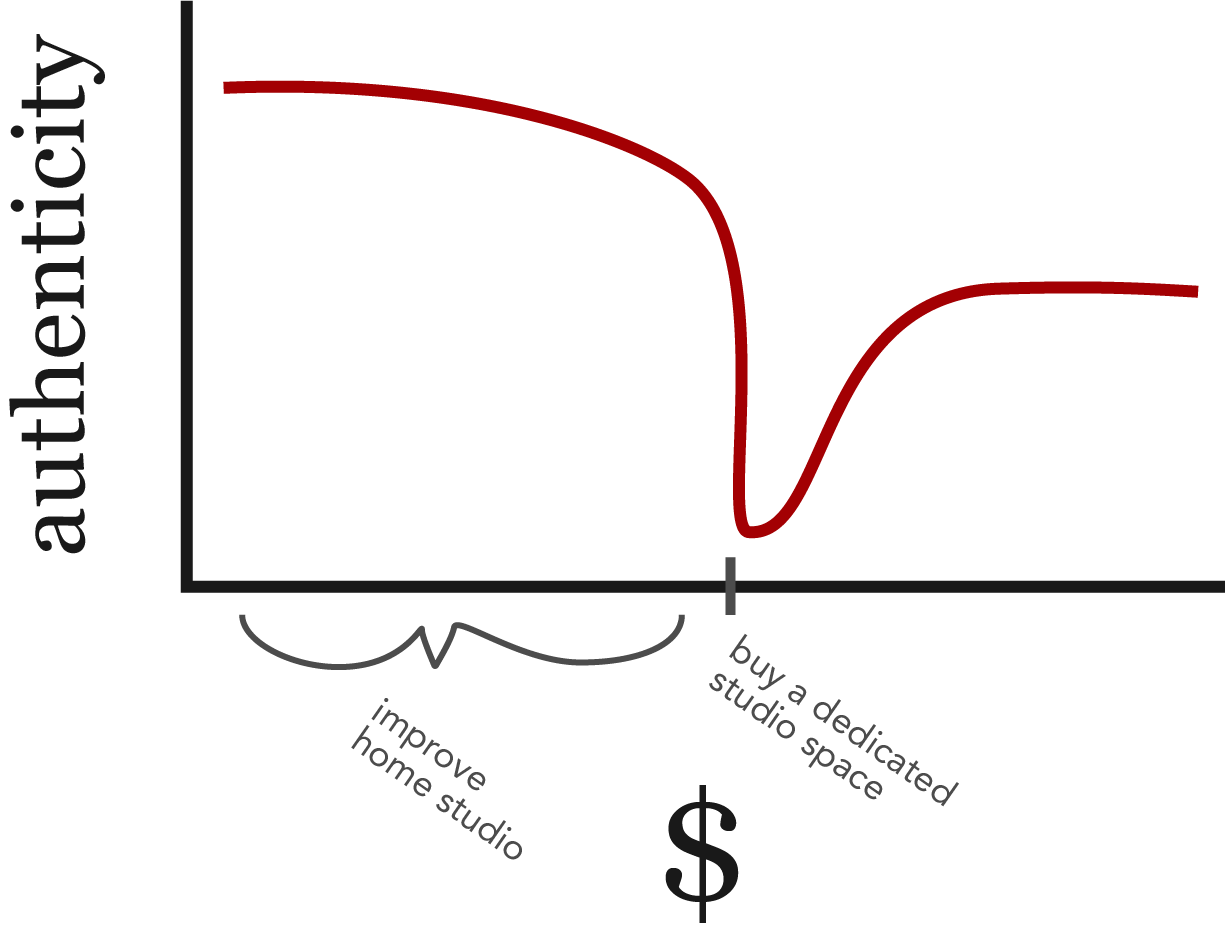
Notice how even after you spend a lot of money to recreate the authenticity that comes for free, you will never completely reach that level again because the new production environment is inherently fabricated.
Now, there is a trust that comes from the establishment of actual production value and a production environment, but I’m not sure that it’s necessarily a greater level of trust than that which comes from real, free authenticity.
And the good news is that right now, with absolutely nothing, you’re already at the peak of the authenticity curve.
So take advantage of it.
-
put to use right away
◆
2 minutesREAD POST
Yesterday I asked about how those content creators that you respect online gained your trust and attention.
I want to highlight this response from a fellow list member named Jared. We were discussing a church media creator and educator that he follows named Brady Shearer, and when I asked how he first discovered the content he said:
“
I think it was a social media video with tips about making videos for church. It was a shorter, 10 minute-ish, video with all kinds of helpful tips that I put into use right away.
(shared with permission, edited for clarity, emphasis mine)
That last part is key: “all kinds of helpful tips that I put into use right away.”
This is a great example of the power of utility value, which I think is probably the most effective form of value for gaining an audience who is primed to become customers. (Which, by the way, Jared has also made purchases from Brady after discovering his content.)
Jared’s experience lines up pretty well with my own, too. When I look at those channels I’ve followed for the longest—and specifically those for which I have become a customer of the actual business—I can trace nearly all of them back to a single moment when I needed the information they were sharing right away, and from there started exploring the rest of what they had to say.
So . . .
What can your content offer to your customers that they can put into use right away?
~ ~ ~
P.S. Jared also mentioned to me that a big part of the reason he continues to follow Brady is because of his perceived authenticity and genuine desire to provide value through his content rather than simply capture value.
-
how’d it get that way?
◆
1 minuteREAD POST
Think of the content creators that you respect the most.
Particularly the ones you feel like you have gotten a lot of personal benefit from.
(Bonus points if you’ve actually become a customer of theirs.)
Now ask yourself, how did it get that way?
How did you find them?
Why did you decide to keep paying attention to their content?
What did they offer that moved you over the edge from content consumer to paying customer?
I’d love to hear your experiences and thoughts if anyone wants to be brave and hit reply!
-
word-of-mouth
◆
1 minuteREAD POST
A lot of small businesses rely on word-of-mouth to get new business.
But relying on word-of-mouth can sometimes be like a game of telephone.
What people think you do doesn’t always perfectly align with what you actually offer. (This is more true the more specialized you are at what you do.)
When that happens you can end up spending unnecessary time explaining what you do and don’t do for unqualified leads.
So . . .
You can keep relying on word-of-mouth and hope that enough of the right people find you.
Or you can start publishing content and be your own word-of-mouth.
-
random DIY content creation tips, vol. 2
◆
1 minuteREAD POST
Here are a few more tips to help you get started creating content in your medium of choice:
video/photo
- avoid having your subject directly against a wall, if you are able to add depth to the shot in any way it will usually make it more interesting
- having the subject closer to the camera and farther from the background is a natural way to add depth-of-field, which is what portrait mode on your phone imitates
~ ~ ~
audio podcasting
- if you buy a microphone, learn if it’s directional or omnidirectional
- if it’s directional, make sure it’s pointed at your mouth, not the ceiling
- on a similar note, make sure you maintain a consistent distance between your mouth and the microphone during recording or else you may have a lot of variance in the volume levels and sound quality
~ ~ ~
video editing
- Jump cuts are okay, especially if it’s a fairly informal video style. It can be tempting to add a transition like a cross dissolve to cover jump cuts, but that usually just makes it more noticeable.
- If you really want to cover up a jump cut, here are two pro-moves:
- Punch-in (i.e. zoom the shot in about 20%)
- This also gives you a second cover because you can zoom back out at the next jump cut.
- Cut away to something else and then come back
- This is very helpful for covering up a series of jump cuts fairly close together.
- Punch-in (i.e. zoom the shot in about 20%)
Check out the previous set of tips here.
Was this helpful? Want more like this? Have questions? Let me know!
- avoid having your subject directly against a wall, if you are able to add depth to the shot in any way it will usually make it more interesting
-
no McGuffins
◆
1 minuteREAD POST
In film theory, a McGuffin is a story element which drives the plot and is essential to the motivations of the characters, but which is insignificant to the audience.
Maps, treasures, ticking time bombs, glass slippers, magic rings—you get the idea.
The McGuffin is fictional, which means it can’t actually help or hurt the audience, so the audience doesn’t really care about it one way or the other. We only care how it affects the development of the characters and the plot.
Here’s the thing . . .
It can be tempting to create content about something that is very interesting and motivating to you, but if it is unattainable by the audience then it’s just a McGuffin.
McGuffins aren’t bad, per se, but they are a pretty clear sign that you’ve crossed over into the realm of entertainment rather than education or anything else you might be aiming for in your content.
Remember, if your content revolves around a McGuffin, it’s not actually the McGuffin which is the subject of interest, it’s you.
-
the two modes of a social media feed
◆
1 minuteREAD POST
People primarily use their social media feeds for two things:
- to stay “up-to-date”
- to “shut their brains off”
What that exactly looks like for each person might be slightly different, but ultimately this means that everything on social media effectively becomes either news or entertainment. (And the push toward algorithmically driven feeds is shifting the balance far more in favor of the latter than the former.)
Anything which can’t easily be converted into one of these two modes in the mind of the audience is likely to simply be considered annoying (i.e. a waste of time).
-
tangential value
◆
1 minuteREAD POST
The Michelin brothers were masters at creating value.
Not only did they produce a product, the pneumatic tire, which was objectively superior to the solid-rubber contemporary standard, but they frequently invested in marketing which provided genuine value to their customers (i.e. anyone with a bicycle or an automobile).
The most famous, although far from the only, example is the Michelin Guide with its maps and restaurant star rating system.
Of course, the point of the guide was to encourage travel, thereby increasing the demand for tires,1 but it also created genuine value for tourists and foodies, and it’s still a world-standard for restaurants nearly a century later.
So let’s take a step back . . .
The Michelin Guide is content created by a tire company which provides intrinsic and extrinsic value through its maps and recommendations, respectively.
But they also treat this content like a product, because that’s what it is. Imagine how much time, R&D, and resources go into producing a full travel guide.
And all this extra value is created in service of an industry which is tangential to the actual business.
So, when you’re thinking of ways to provide value to your customers, don’t be afraid to think beyond your primary offering.
~ ~ ~
P.S. If you want to hear more about the business acumen of the Michelin Brothers, I recommend this episode of the Founders Podcast.
- As evidence of the tire-centric nature of the guide, these are the criteria descriptions of the Michelin star ratings:
* – “A very good restaurant in its category”
** – “Excellent cooking, worth a detour”
*** – “Exceptional cuisine, worth a special journey” ↩︎
- As evidence of the tire-centric nature of the guide, these are the criteria descriptions of the Michelin star ratings:
-
re: strategy
◆
1 minuteREAD POST
In response to my recent message about strategy, in which I said that every tactical decision has a strategy assumption built into it, I got this question from a fellow list member:
“
But one could also deploy random tactics, each based on its own reactionary rationale. What would the assumptions be in that scenario?
Maybe the assumption is that reaction is better than forethought?
Good question!
Here was my response:
“
Well unless the tactic is to do nothing, the most basic assumption is that the battle is worth waging in the first place. And if that’s the case then there’s some kind of “why” behind that even if you haven’t articulated it.
I guess same goes if you decide it’s not worth it.
Maybe the only non-strategy is to alternately do and don’t do on a whim.
~ ~ ~
Here’s the thing . . .
A strategy is simply a plan for achieving an ultimate goal.
You have an ultimate goal for your business, so you have some kind of strategy for achieving it, even if you haven’t said it out loud or put it on paper. If you didn’t have any plan you wouldn’t take any action, so you wouldn’t have a business.
There are all kinds of strategies.
But not all strategies are winning strategies.
If you wrote down the strategy assumptions built into every one of your day-to-day decisions, would it look like a winning strategy?
Prefer long form?

